
Getting DJs to review your music is one of the smartest ways to refine your tracks before releasing them. DJs test your sound on big systems and gauge crowd reactions, offering insights you can’t get in the studio. Here’s how you can connect with DJs and use their feedback to improve:
- Target the right DJs: Focus on those who play your subgenre (e.g., Tech House, Melodic Techno) to increase response rates.
- Personalize your outreach: Send short, tailored messages referencing the DJ’s style or recent sets. Include streaming links (like private SoundCloud links) and downloadable files in high-quality formats (WAV, AIFF, or MP3).
- Use promo tools: Platforms like Promoly simplify outreach, track engagement, and collect feedback, saving time and effort.
- Organize feedback: Use spreadsheets to track who responds, what they say, and how to improve your track.
- Follow up professionally: Send polite reminders and thank DJs for their input, even if they don’t play your track.
Getting meaningful feedback is about building relationships, not spamming. Start small with local and mid-level DJs, then work your way up to bigger names. Their input can help you tweak your sound for both the dancefloor and streaming playlists.
3 techniques for getting feedback to improve your music production
sbb-itb-888513b
Finding DJs in Your Genre
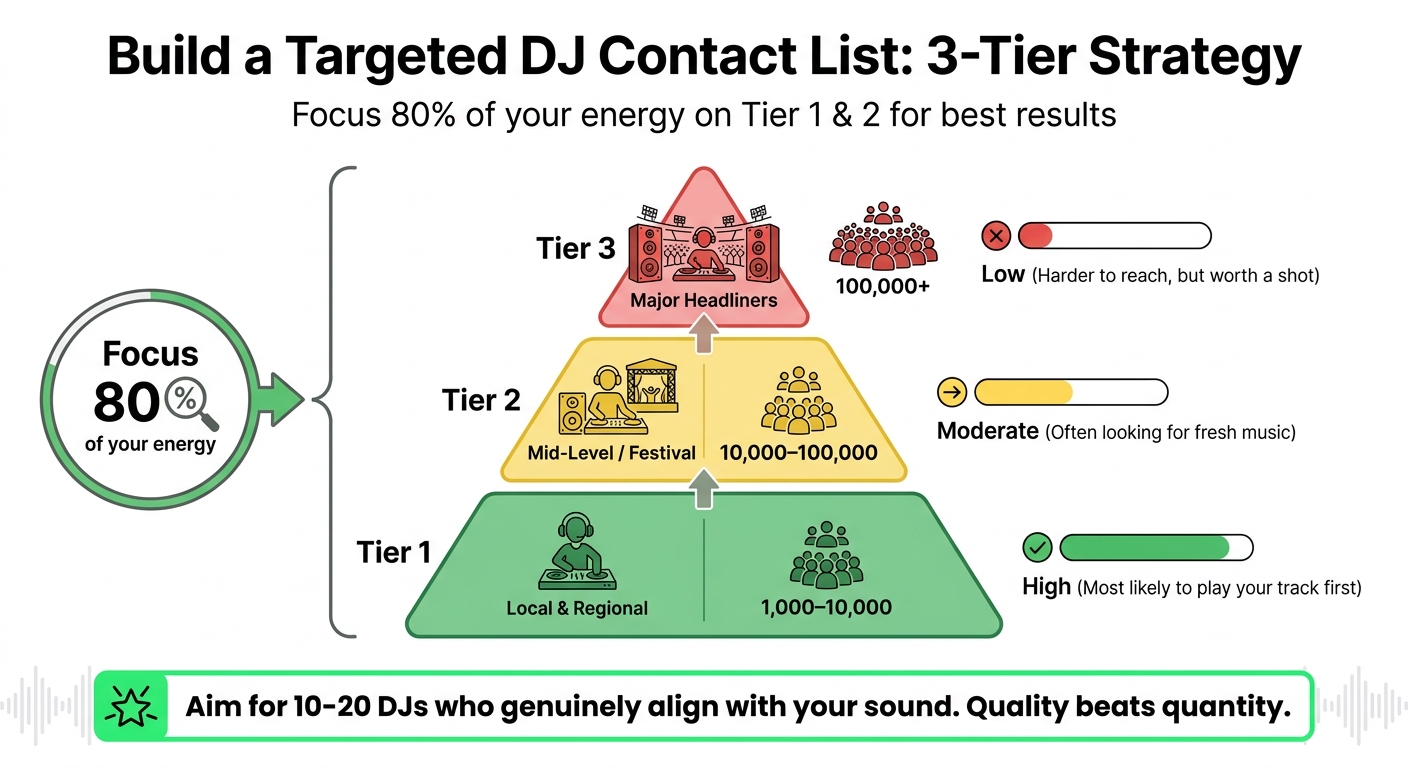
DJ Tier Targeting Strategy: Contact List Segmentation by Follower Count and Response Rate
Skip the scattershot approach – focus on DJs who spin your specific subgenre. This targeted strategy can dramatically improve your response rates, jumping from a typical 3–5% to as high as 30% or more.
Instead of using broad labels like "EDM", pinpoint your subgenre. Are you creating Tech House, Melodic Techno, Deep House, Progressive House, or Bass House? Once you’ve nailed that down, compare your track to 5–10 well-known tracks in the same style. Check if your BPM, energy, and structure match up. As industry expert Manasa Boggaram puts it:
"DJs receive enough music in the genre they usually play. They wouldn’t particularly be interested in including music that doesn’t blend well with their sets."
The goal here isn’t just to send your track to anyone – it’s to connect with DJs who can offer meaningful feedback and might actually play your music. Next, let’s dig into how to research DJ sets and build a solid contact list.
Listen to DJ Sets and Mixes
Platforms like SoundCloud and Mixcloud are goldmines for understanding a DJ’s style. Dive into their most recent 1–2 hour sets to see if your track fits their vibe. You can also check their SoundCloud "likes" to get a sense of what resonates with them.
For a more detailed approach, use tools like 1001Tracklists to identify DJs already supporting tracks similar to yours. Don’t stop there – look at genre-specific charts on Beatport and Traxsource, and even Bandcamp profiles of users who’ve purchased music in your style. These steps can help you find DJs and producers who are naturally aligned with your sound.
Build a Targeted Contact List
Once you’ve identified potential DJs, organize them into tiers based on their reach and likelihood of responding:
| Tier | DJ Type | Follower Range | Likelihood of Response |
|---|---|---|---|
| Tier 1 | Local & Regional | 1,000–10,000 | High (Most likely to play your track first) |
| Tier 2 | Mid-Level / Festival | 10,000–100,000 | Moderate (Often looking for fresh music) |
| Tier 3 | Major Headliners | 100,000+ | Low (Harder to reach, but worth a shot) |
Put about 80% of your energy into Tier 1 and Tier 2 DJs. These are the ones most likely to reply and help you gain traction. Aim for a list of 10–20 DJs who genuinely align with your sound. Quality beats quantity here – you’ll get better results by focusing on DJs who are a good match rather than blasting your track to hundreds of random contacts.
To save time and increase your chances of success, check Instagram and SoundCloud bios for promo email addresses. Many DJs list their preferred way to receive new music, which can streamline your outreach.
Once your contact list is ready, the next step is crafting professional, personalized messages. This approach not only boosts your response rates but also sets the foundation for meaningful follow-ups and lasting connections.
Writing Professional Outreach Messages
Once your targeted DJ list is ready, the next step is crafting a message that grabs attention. DJs are inundated with promo emails daily, so a generic "check out my track" message is likely to get lost in the shuffle. To stand out, your outreach needs to be concise, relevant, and personal.
"In the crowded digital landscape where DJs are constantly bombarded with new music, crafting a personalised message is essential to stand out and capture their attention."
– Audio Jacked
The key is to keep your email short – just one or two sentences that reference something specific about the DJ’s recent work while explaining why your track fits their style. For example: "I caught your Melodic Techno set from Output Brooklyn last week – loved how you blended those driving basslines with atmospheric pads. My new track ‘Midnight Drive’ at 126 BPM mirrors that energy perfectly."
Personalize Each Message
Address the DJ by name and mention something specific, like a recent set, track, or chart they’ve been featured on. This shows you’ve done your homework and aren’t just sending a mass email.
"Avoid sending generic, mass-produced emails or direct messages, as these are often quickly disregarded."
– Audio Jacked
Be clear about why your track is a good fit. For instance, if your track is a Tech House banger at 128 BPM with punchy drums and a rolling bassline, reference how it aligns with the DJ’s recent style or playlist. Using genre-specific language demonstrates that you understand their sound. On the flip side, don’t pitch a 140 BPM Drum & Bass track to a Deep House DJ – it’s unlikely to resonate.
Include Streaming Links and Download Files
Make it easy for DJs to access your track by including both streaming and download options. A private SoundCloud link is ideal, as it displays your cover art and lets you track listens. Enable downloads and offer high-quality formats like WAV or AIFF for club playback, alongside a 320kbps MP3 for quick previews.
Here’s a quick breakdown of the best formats for DJ promos:
| Format | Quality | Metadata Support | Best Use for DJ Promo |
|---|---|---|---|
| WAV | Highest (Uncompressed) | None | High-quality playback; potential organization issues |
| AIFF | Highest (Uncompressed) | Yes | High-quality playback with full metadata support |
| MP3 (320kbps) | Good (Lossy) | Yes | Broad compatibility and convenience for quick previews |
Label your files clearly using a consistent naming convention like ArtistName_TrackTitle_OriginalMix.wav. Also, add metadata tags with details like your artist name, track title, BPM, and key. This helps DJs keep their digital libraries organized and ensures they can easily find your track when needed.
Finally, include a link to your Electronic Press Kit (EPK). This should contain your bio, professional photos, and social media links, all in one place. Keep it simple and streamlined – one click should provide everything the DJ needs to learn more about you. A well-organized EPK can pave the way for stronger connections and effective follow-ups.
Using Promo Platforms to Get Feedback
Personalized emails are great for building one-on-one relationships, but they can be a logistical nightmare when you’re trying to reach a large group of DJs. Sending individual emails means juggling multiple conversations, tracking who opened what, and remembering to follow up with people who didn’t respond. Promo platforms solve this headache by centralizing everything. They let you scale your outreach while keeping all feedback neatly organized in one place. For example, Promoly, used by over 500 labels worldwide, offers a 7-day free trial with 150 free sends – no credit card required.
Here’s how Promoly simplifies both outreach and feedback gathering.
Send Promos with Promoly
Promoly’s Campaign Dashboard makes creating promo mailouts incredibly quick – just upload your track, artwork, and description, and you’re good to go in under a minute. If your track has a UPC, Promoly even pulls in metadata like the track title and artist name automatically, saving you time. You can send promos to your own contact list or use the Tastemaker Network, which connects you with over 1,300 DJs who have opted in to receive promos.
"It takes about one minute to start and send a campaign but still has everything you need."
– TJ Flanders, Never Say Die Records
Promoly’s AI does some heavy lifting too. It drafts professional promo copy for you and suggests contacts based on their genre preferences and how they’ve engaged with your promos in the past. You can also segment your audience by location or music style, ensuring your track lands in the inboxes of DJs most likely to play it.
Once your promo is sent, the focus shifts to monitoring how it’s received and acting on the feedback.
Track Feedback in Real-Time
Promoly’s system requires DJs to rate and comment on your track before they can download it. This means every download comes with useful insights – whether it’s a positive comment like "Perfect for my Friday night warm-up set" or constructive criticism about the mix. The real-time dashboard keeps you updated on who’s engaging with your promo by tracking opens, plays, downloads, and feedback as it happens.
To make sure no one slips through the cracks, automated reminders nudge DJs who haven’t opened your promo yet, increasing your chances of a response.
"I’ve received more feedback than ever before! The software is so easy to use."
– Corey T., Artist/User
Following Up and Building Connections
Building strong, lasting relationships with DJs can take your music from a one-time spin to being a regular feature in their sets. The key lies in what happens after that first contact. While follow-up emails help maintain digital connections, nothing beats the impact of meeting DJs in person.
Send Follow-Up Emails
After your initial submission, wait about two weeks before sending a follow-up email. This gives DJs enough breathing room to go through their inbox without feeling pressured. Keep your message short and to the point – include the streaming link again so they can easily revisit your track. Stick to just one follow-up email; sending multiple can come across as pushy or unprofessional.
If your track gets rejected, don’t let it discourage you. Respond politely and ask for specific feedback on how you can improve. This approach not only helps you grow but also shows DJs that you’re serious about your craft. As Promoly puts it:
"If a DJ rejects your track, be polite and get helpful feedback. Find out how you can polish your track to suit their needs".
Connect at Events and on Social Media
While emails are a great starting point, face-to-face interactions and social media engagement can take your relationships to the next level. Meeting DJs at shows or events creates a personal connection that emails simply can’t replicate. Local DJs are especially valuable since they can test your music live and share firsthand how the crowd reacts. Plus, attending events connects you with fans who are tapped into the local scene – potential supporters who might share your tracks within their circles.
On social media, Instagram stands out for its higher response rates. When reaching out, mention something specific, like a recent set or radio show, to show that you’re familiar with their work. You can also join producer-focused groups on platforms like Facebook or SoundCloud to build a network of peers who can offer constructive feedback. As producer Pheek explains:
"Other artists usually have nothing to gain from you except a possible friendship if they like you and your music, so the chances that they’re true to their word are good".
Investing time and effort into these connections can pay off in a big way. A single DJ who regularly supports your music is far more valuable than hundreds of passive downloads.
Using Feedback to Improve Your Music
Once you’ve gathered and organized DJ feedback, the real work begins: turning those insights into actionable changes for your track. Feedback is just the starting point – it’s up to you to analyze it carefully, spot patterns, and focus on the updates that will make the biggest difference.
Organize Feedback for Easy Analysis
A single, well-structured spreadsheet can be your best tool for managing DJ feedback. Include columns like DJ Name, Contact Method, Analytics Data (e.g., listen duration or downloads), Follow-up Dates, and Final Results. This setup makes it easier to identify recurring themes. For example, if multiple DJs comment that your bassline is muddy or your intro feels too long, those are clear areas to address.
Start by reviewing engagement metrics. DJs who listen to your entire track and download it are showing strong interest – reach out to them within 24 hours. On the flip side, if analytics reveal that most DJs stop listening after 30 seconds, it could mean your hook isn’t grabbing attention or the track isn’t resonating with the right audience. As OBSCUUR explains, detailed feedback is invaluable:
"Comments like ‘Huge reaction on the dancefloor in Ibiza’ or ‘Supporting this on my Rinse FM show’ are pure gold. This isn’t just for the artist’s ego; it’s critical market research".
Break down the feedback into two categories: technical issues (like mixing, mastering, or overall sound quality) and creative suggestions (such as arrangement, energy flow, or sound design). Prioritize fixing technical problems first – poor mixing can make your track sound weak or distorted on club systems, which can lead to DJs rejecting it outright.
Revise and Test Your Tracks
Once you’ve identified patterns in the feedback, take a brief pause before diving into revisions. This short break allows you to approach criticism with a clear, objective mindset rather than reacting emotionally. Focus on feedback that aligns with your vision for the track and its intended audience. For instance, a techno DJ’s input might not carry much weight if you’re producing a house track.
After revising, test the updated track with a new group of DJs to measure its performance. Make sure your revised files are properly tagged with accurate BPM, key, and genre information – this makes it easier for DJs to integrate your track into their sets. When reaching out to new contacts, highlight the changes you’ve made based on previous feedback. This demonstrates that you’re serious about your work and open to professional input.
Conclusion
Getting feedback from DJs doesn’t have to be complicated. It all starts with doing your homework: focus on DJs whose style aligns with your music. This way, your track has a better shot at fitting into their sets, which naturally leads to more meaningful and constructive feedback.
When reaching out, keep your messages short and personal. Highlight why your track works for that particular DJ, and don’t forget to include professional-looking artwork. Always provide streaming links and simple download options – platforms like SoundCloud for streaming and Dropbox or WeTransfer for downloads work best. Avoid sending large MP3 files as attachments, as they can be a hassle to deal with. A personal touch in your communication not only makes a stronger impression but also helps you manage your promotions more effectively.
For an even smoother process, platforms like Promoly can be a game-changer. With an impressive 73% average open rate and campaigns that take about 60 seconds to launch, it’s a tool designed for efficiency. As TJ Flanders from Never Say Die Records puts it:
"It takes about one minute to start and send a campaign but still delivers all essentials".
One standout feature is Promoly’s feedback gating, which requires DJs to rate and comment on your track before they can download it. This ensures you’re not just sending out promos but also gathering valuable insights for every release. Lastly, don’t forget to follow up. A polite reminder after two weeks – or using automated tools to re-engage DJs who haven’t opened your promo – can make all the difference.
FAQs
How many DJs should I send my track to?
When deciding how many DJs to reach out to, it’s better to focus on quality over quantity. Start with a carefully selected list of DJs whose style aligns with your music. A few dozen, thoroughly researched, is a solid starting point. This approach ensures your efforts are targeted and effective.
Taking the time to craft personalized messages increases your chances of receiving meaningful feedback and support. Building genuine connections with the right DJs can lead to more impactful insights and stronger relationships.
What’s the best way to get DJs to actually reply with feedback?
The most effective way to get DJs to respond with feedback is by crafting professional, targeted outreach. Start with personalized emails that demonstrate you’ve done your homework on their style and preferences. Briefly introduce your track, keeping it concise and relevant, and make sure to include a direct, streamable link through platforms like SoundCloud or WeTransfer for easy access. Tools like Promoly can also be a game-changer, as they help you monitor engagement and gather feedback, simplifying the process for DJs to reply and share their thoughts.
How do I know which DJ feedback to trust and act on?
To spot reliable DJ feedback, look for comments that are constructive, detailed, and consistent. Feedback from DJs whose style and audience align with your music tends to carry more weight. Building connections with DJs who actively support artists in your genre can also provide more meaningful insights. The most trustworthy feedback aligns with your creative vision and includes actionable advice instead of vague or generic remarks.
Leave a Reply