More than 120,000 tracks hit streaming platforms each day, so I don’t look for the biggest names first. I look for the people who get listeners to act.
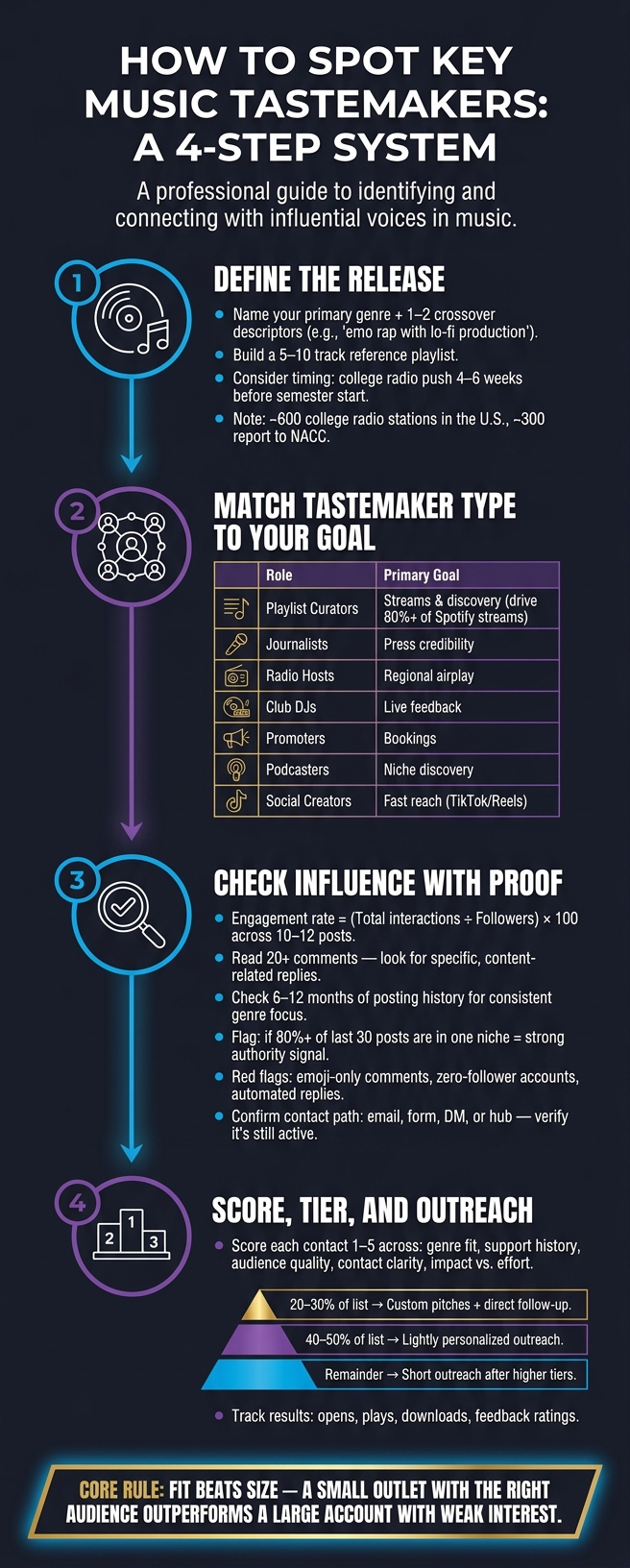
If I want a release to get streams, press, airplay, bookings, or social traction, I start with four steps:
- Define the release clearly by genre, crossover sound, scene, and timing
- Group tastemakers by job such as curators, writers, radio hosts, DJs, promoters, podcasters, and creators
- Check influence with proof like engagement, repeat support, niche focus, and response history
- Rank contacts before outreach so time and promo spend go to the best-fit names
The main idea is simple: fit beats size. A small outlet with the right audience can do more than a large account with weak interest. I also need a working contact path, clear submission rules, and a way to track opens, plays, downloads, and feedback after I send promos.
This article breaks that process into a short, usable system I can apply to one single, EP, or album cycle.
How to Find & Rank Music Tastemakers: A 4-Step System
How to Approach Tastemakers for Music Reviews & Build Hype for Your Music Releases
1. Start with Your Genre, Scene, and Release
Start with one release, not your whole artist brand. A single, EP, or album cycle gives you a much sharper filter: does this tastemaker support music like this, right now?
Match the Release to a Clear Genre Lane
Begin by naming your primary genre plus one or two crossover descriptors. “Hip-hop” is too broad. “Emo rap with lo-fi production” is a lane. “House” is too broad too; “jackin’ house” or “deep house” gives you something you can actually use. Tastemakers build their reputation around a specific sound, so off-target pitches usually get ignored.
Use that genre lane to find nearby releases. Put together a short reference playlist with 5–10 similar tracks. Then check the genre labels on Spotify and Apple Music, and pay attention to the terms that show up again and again. That’s the language to bring into your pitch.
Scene and timing matter too. The U.S. has roughly 600 college radio stations, with about 300 reporting to the NACC chart. If your release fits indie, alternative, or emerging hip-hop, go after those stations 4–6 weeks before a semester starts. Summer often works better for festival-friendly and upbeat music. Late Q4 gets crowded with major releases and holiday music, which can bury smaller campaigns. Scene shows up in local radio, shows, playlists, and venue flyers, so use those as early signs of where your release fits.
Build a Starting List from Existing Support Patterns
Next, trace who already supports artists like you. The fastest way to find relevant tastemakers is to follow the support trail of adjacent artists – acts one tier above you with a similar sound and audience. Check who appears in “Fans Also Like” on Spotify, scan playlist tracklists that include your reference tracks, and read press coverage of artists you admire to see which names keep popping up.
What matters most is repeated support, not a one-off mention. A blog that keeps covering similar artists is building a clear story around your scene. The same idea applies to radio shows, podcast hosts, DJ charts, and event promoters. If the same name shows up across playlists, radio archives, and venue flyers, move it to the top of your list.
2. Match Tastemaker Types to Your Release Goals
Now that you have a starting list, sort each name by the role it can play for this release. Tie every contact to the outcome you want: streams, press, airplay, bookings, or social lift. The idea is simple: use the right contact for the job, then double-check fit and the best way to reach them.
Playlist Curators, Journalists, and Radio Hosts
Playlist curators are your best bet for stream volume and online discovery. Playlists drive over 80% of all streams on Spotify. So this group can have a huge effect on how far a release travels. When you size up a curator, check for regular updates, a clear genre lane, and signs that listeners respond to new adds.
Journalists help frame the story around your release and add credibility. Put your focus on writers who cover your genre on a steady basis. If someone only dips into your lane once in a while, they’re usually a weaker fit.
Radio hosts work best for regional credibility and hand-picked airplay. Send promos 3–4 weeks before release, and include a clean edit if the track is explicit. That same basic approach carries over to DJs, promoters, podcasters, and social creators too, but each group looks for a different kind of signal.
DJs, Promoters, Podcasters, and Social Creators
These contacts matter when streams aren’t your only target.
Club DJs give you direct feedback on how a track lands in a room. That kind of response can tell you a lot, fast. Split them by sub-genre and venue type, and make sure your metadata – artist name, track title, label, and release date – is complete.
Promoters often look at release momentum when making booking calls. Reach out with mixes or live recordings months before festival season, when many booking decisions are being locked in.
Podcasters can open the door to niche discovery through interviews and dedicated music segments. Look for strong interview depth and clear audience engagement.
Social creators on TikTok and Instagram Reels can move fast. They’re often the quickest path to reach, but don’t get distracted by follower count alone. Put more weight on engagement and audience fit.
| Tastemaker | Where to Find Them | Key Signals |
|---|---|---|
| Playlist Curators | Spotify, YouTube, SoundCloud | Update frequency, genre fit, listener engagement |
| Journalists | Music blogs, niche publications | Consistent genre beat, coverage history |
| Radio Hosts | College stations, community radio | Airplay history, reporting system usage |
| Club DJs | DJ pools, clubs, festivals | Download rates, track ratings, tempo fit |
| Promoters | Local venues, festival booking offices | Gig history, mix engagement |
| Podcasters | Podcast directories, music shows | Audience engagement, interview depth |
| Social Creators | TikTok, Instagram, Discord | Engagement-to-follower ratio, niche trust, user-generated content |
Once you’ve matched names to goals, check which contacts have actual influence and a clear, usable contact path.
sbb-itb-888513b
3. Check for Real Influence, Fit, and Contact Paths
Look Beyond Follower Count When Checking Influence
Now that you have a shortlist, the next step is simple: figure out who can actually move attention for this release.
Follower count helps, but it’s only a starting point. What you want is repeatable response. When this person backs a track, do people listen, click, comment, save, or follow?
A good place to start is engagement rate. Take total interactions, divide by follower count, and multiply by 100 across 10–12 recent posts. That gives you a much better read than raw audience size alone.
Then look closer at the comments. Emoji-only replies often point to weak engagement. Read at least 20 comments across a few posts. You’re looking for specific, content-related responses from different accounts. If the replies are full of zero-follower profiles or accounts that look automated, that’s a red flag.
Consistency matters too. Go back 6–12 months and review posts, playlists, or episodes. Is there a steady genre focus? Do they post on a regular cadence? If more than 80% of their last 30 posts sit inside one clear niche, that’s a strong sign that they hold real authority in your lane.
Past results matter even more. Check whether support for similar artists led to bumps in streams, followers, or engagement around the date of that support. That’s the clearest sign that influence turns into action.
Confirm Contact Details and Submission Preferences
Once someone looks like a fit, make sure there’s an actual way to reach them.
Look for one current submission path, such as:
- form
- hub
- DM instructions
Then verify that the contact path still works. Check post dates, make sure linked forms are live, and see whether the website has been updated lately. Also confirm their genre preferences. Many curators and DJs spell this out in Spotify playlist descriptions, SoundCloud pages, or social bios.
If they ask for a certain subject line, file type, or a private streaming link instead of a download, follow that exactly. Miss the instructions, and it’s easy to get ignored.
At this stage, keep only the contacts that have both a clear fit and a usable way in. Then sort them by priority.
4. Organize, Rank, and Prepare for Outreach
Build a Tiered Shortlist with Notes and Priority Levels
Once you’ve confirmed fit and a clear contact path, the next step is simple: rank the list by likely impact.
Score each contact from 1–5 across these areas: genre fit, support history, audience quality, contact clarity, and impact vs. effort. Then sort them into three tiers. Use 18–25 for Tier 1, 10–17 for Tier 2, and 0–9 for Tier 3. A solid rule of thumb is to keep the split around 20%–30% Tier 1, 40%–50% Tier 2, and the rest Tier 3.
That way, your outreach matches the chance of a result:
- Tier 1 gets custom pitches and direct follow-up
- Tier 2 gets lightly personalized outreach
- Tier 3 gets short, relevant outreach after higher-priority contacts are done
Keep everything in one shared sheet so ranking and contact details live in the same place:
| Field | What It’s For |
|---|---|
| Name / Handle | Personalization in outreach |
| Role | Tailor the pitch (DJ vs. journalist vs. curator) |
| Region / Primary Market | Helps prioritize key markets for touring or press |
| Tier | Drive sequencing and effort allocation |
| Genre Tags | Filter by release quickly |
| Contact Method | Standardize outreach and avoid wrong channels |
| Activity Status | Prevent over-contacting and track relationship freshness |
| Support History Notes | Inform future pitches with past context |
Before each new release, review your Tier 1 and Tier 2 contacts. Check that their role still fits, their contact details still work, and they’re still active. If someone has gone quiet or shifted focus, take them out. A shorter list with the right people beats a bloated one every time.
Use a Promo Workflow That Tracks Opens, Plays, Downloads, and Feedback
After ranking the list, track how each tier responds. That’s how the list gets better from one campaign to the next.
Once your list starts to grow, it helps to use a promo platform that does more than send links. Promoly lets you send segmented promo campaigns and track opens, plays, downloads, and feedback in real time. If someone plays a release more than once, that’s often a sign of interest. That’s usually the right moment for a personal follow-up. Over time, response data shows which tastemaker types actually help move your release.
Promoly also collects star ratings and written feedback from tastemakers. That gives you useful notes you can log right into your contact sheet. If a DJ leaves a 4/5 rating and asks for a radio edit, that’s not just feedback for today. It’s context you can use on the next release too. Automated reminders also help keep follow-up on track.
After each campaign, use engagement data to adjust your tiers. Contacts who keep opening, playing, and downloading can move up. Contacts who never engage can move down or come off the list.
Conclusion: Focus on Patterns, Fit, and Follow-Through
After you rank your list, keep the focus on fit, not volume. The core rule is simple: match the release to the tastemaker’s audience, role, and response history. Different release goals call for different types of tastemakers. Match first; outreach later.
A smaller, highly engaged niche contact is often better than a large but indifferent one. Fit comes first. Proof of influence comes next.
It also helps to look for repeat support across releases and channels. One placement is nice, but steady backing tells you a lot more.
Once the list is checked, the last step is straightforward: follow through fast and track the response. When a tastemaker backs your release, thank them directly, share their feature on your own channels, and log the outcome. Use a promo workflow tool like Promoly to track opens, plays, downloads, and feedback. Thank, share, and log each result so every release starts with better context.
If the release is defined, the match is clear, influence is verified, contact paths work, and the list is ranked, the campaign is ready.
FAQs
How many tastemakers should I target first?
Start with quality over quantity. In many cases, just five well-chosen, well-researched tastemakers are enough to get things moving.
For niche campaigns, a focused list of 150 to 300 active, genre-specific contacts often does better than a generic list of 1,000. The goal isn’t the biggest list you can build. It’s getting in front of people who are likely to care, respond, and help spread the word.
Put simply: prioritize engagement over broad reach.
What makes a tastemaker worth pitching?
A tastemaker is worth pitching when they’re active, match your genre or subgenre, and already support music like yours. Size and fame matter less than fit. If someone has a real interest in your sound, you’re much more likely to get honest engagement and support that lasts longer than a one-off play.
That’s why it helps to do a little homework. Check their tracklists. Watch what they post and share on social media. See who they’ve backed before. You’re not just looking for a big name – you’re looking for someone who makes you think, yeah, this person would actually get this track.
Promoly can help here too. Use it to group contacts by genre and engagement, so your outreach feels more targeted instead of scattered. In practice, the tastemakers that matter most are often the ones who keep opening your emails, listening to your music, and sending feedback.
When should I start outreach before release day?
Start your outreach before release day. That gives tastemakers enough time to listen, decide if they want to cover the track, and fit it into their schedule.
A simple timing guide:
- Blogs, online publications, and independent playlist curators: 2–4 weeks ahead
- Print magazines: 2–3 months ahead
- Editorial playlists like Spotify: 7 days to 3 weeks ahead
Promoly can help you track opens and feedback during the campaign.
Leave a Reply