
When promoting music, should you prioritize email or social media? Here’s the short answer:
- Email is best for driving revenue, with an average ROI of $36 per $1 spent and open rates of 20–30%. It’s a reliable way to connect directly with fans, free from social media algorithms.
- Social media excels at discovery, reaching new audiences quickly. Platforms like TikTok can expose your music to thousands, but organic reach is limited to 5–10% of followers.
Key takeaway: Use email to build lasting relationships and boost sales. Use social media to create buzz and attract new listeners. The smartest strategy combines both channels.
Quick Comparison
| Metric | Social Media | |
|---|---|---|
| ROI | $36 per $1 spent | $2.80 per $1 spent |
| Reach/Open Rate | 20–30% | 5–10% organic reach |
| Conversion Rate | ~3.19% | ~0.71% |
| Audience Ownership | You own it | Platform-controlled |
| Best For | Sales, loyalty | Discovery, awareness |
Want the best results? Use social media to grow your email list, then rely on email for personalized, high-impact campaigns.
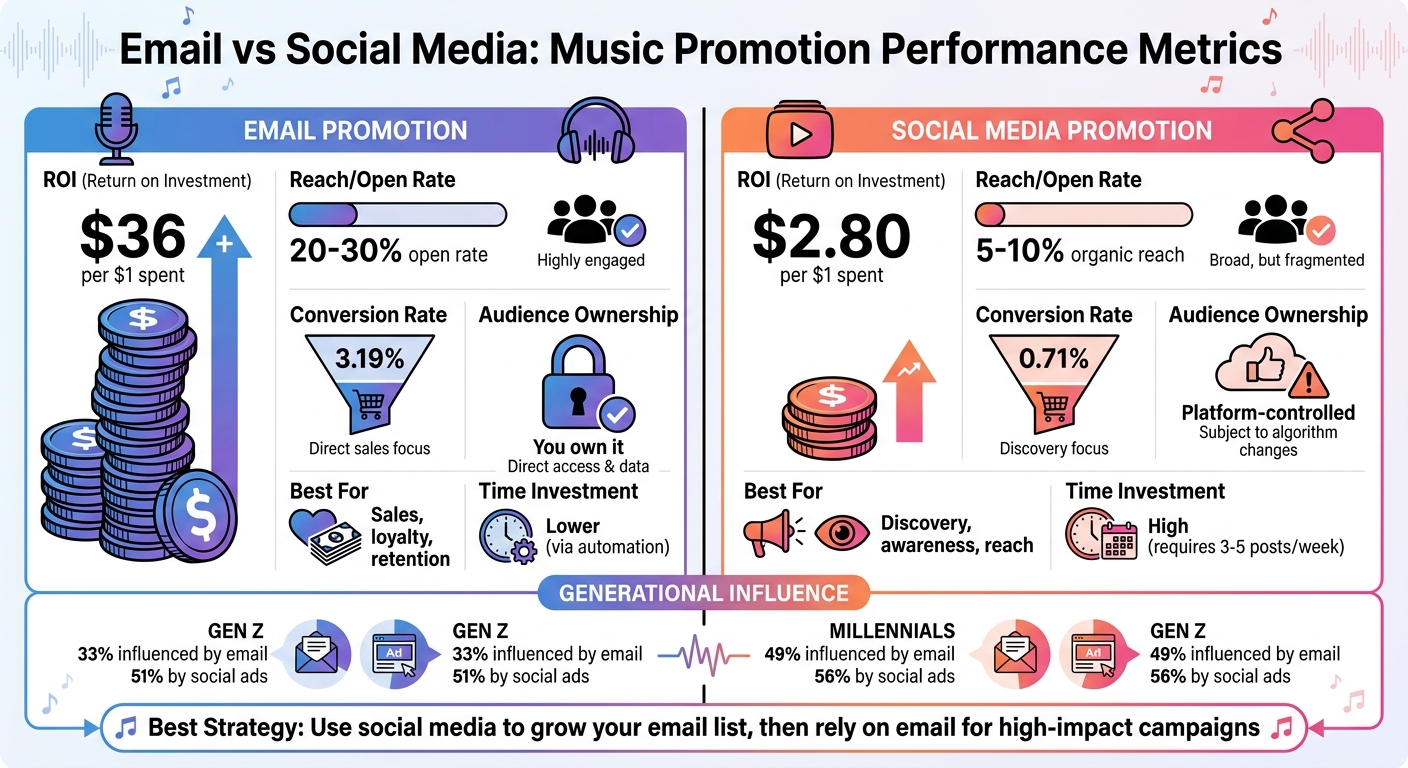
Email vs Social Media Marketing for Musicians: ROI, Reach, and Conversion Comparison
Email for Music Promotion: Pros and Cons
Benefits of Email for Music Promotion
One of the standout advantages of email is that it gives you full control over your audience. Unlike social media platforms, where algorithms decide who sees your posts, email allows you to reach your fans directly, whenever you want. As the Musician Indie Coalition explains:
Social media algorithms will always be out of your control, but your mailing list allows you to directly communicate with fans.
The stats are compelling, too. Email open rates typically range between 20–30%, which is far higher than the 5–10% organic reach seen on social media. Even better, email offers an impressive return on investment – $36 for every $1 spent – compared to social media’s $2.80.
Another big plus? Email lasts longer than social media trends. Fans might switch social platforms or lose interest in one app, but email addresses remain consistent over time. This makes email a reliable way to stay connected. It’s also a fantastic medium for delivering rich, exclusive content – think music videos, behind-the-scenes clips, or unreleased tracks – straight to your fans’ inboxes.
Email also feels personal. It’s like having a 1-on-1 conversation with your fans, creating a deeper connection. This personal touch is great for turning casual listeners into loyal supporters who buy tickets, merch, and more. Plus, tools like Promoly can help you track engagement, showing who opened your emails, clicked on links, or downloaded your music.
That said, email marketing isn’t without its hurdles.
Drawbacks of Email for Music Promotion
While email has plenty of advantages, it comes with some challenges. First, building an email list takes time – and you’ll need to use other channels to do it. Unlike social media, where a viral post can lead to instant exposure, email doesn’t help with discovery. You’ll need to rely on live shows, collaborations, or social media campaigns to drive people to sign up. This makes email most effective as part of a larger promotional strategy rather than a standalone tool.
Another challenge is keeping your audience engaged. If your emails lack quality content or aren’t tailored to your fans’ interests, you could face high unsubscribe rates – sometimes as high as 60% per send. Segmentation is key here. If you’re not dividing your list by factors like location or engagement level, you risk alienating fans with irrelevant messages.
Deliverability is another issue. Even the best-written emails won’t matter if they end up in spam folders. Maintaining a good sender reputation requires consistent, high-quality content. Additionally, there’s a generational divide to consider: while 51% of consumers from older generations are influenced by email, only 33% of Gen Z say the same. Younger audiences often respond better to social media ads.
Finally, email marketing demands time and effort. From creating a content calendar to setting up automated sequences and running regular tests, there’s a lot to manage. For independent artists already balancing production, performances, and promotion, this workload can feel overwhelming.
Social Media for Music Promotion: Pros and Cons
Benefits of Social Media for Music Promotion
One of social media’s greatest advantages is its ability to help new artists get discovered. Unlike email, which requires you to build an audience over time, platforms like TikTok can expose your music to thousands – sometimes millions – of people overnight. In fact, over 75% of TikTok users discover new artists or songs on the platform, and 63% hear songs there before streaming them elsewhere. That kind of reach is tough to replicate through traditional email campaigns.
The results speak for themselves. Songs featured in over 100,000 TikTok videos often see a 250% jump in Spotify streams within just two weeks. This was the case for hits like FIFTY FIFTY’s "Cupid" and Doja Cat’s "Paint the Town Red", which climbed to the top of global charts.
Each platform offers its own unique strengths. Chris Park, Digital Strategy Lead at PromoTrack, highlights this distinction:
"TikTok is for discovery and viral potential; Instagram is for brand building and community."
TikTok functions as a discovery engine, testing your content with small groups and amplifying it if it resonates quickly. Meanwhile, Instagram serves as a tool for nurturing relationships through DMs, Stories, and other features. YouTube adds another layer by offering monetization options like Content ID, additional visibility through Shorts, and long-term credibility with music videos.
Social media also enables real-time fan interaction, something email can’t quite match. Features like live streams, comments, duets, and challenges allow fans to connect with your music instantly. This participatory culture is reflected in the fact that nearly 40% of all TikTok engagement revolves around music-related content. Plus, platforms now include "Add to music app" buttons, making it easier for fans to save songs directly to Spotify or Apple Music.
The best part? You don’t need a huge marketing budget to get started. A simple TikTok account and a short video clip can potentially reach thousands, even if you’re starting from scratch. But while the exposure is massive, it comes with some trade-offs that can affect your long-term strategy.
Drawbacks of Social Media for Music Promotion
For all its benefits, social media has its downsides, especially when it comes to maintaining control over your audience and results. Unlike email lists, where you own the contact information, social platforms dictate how far your content can reach. Algorithms often limit organic visibility, meaning your posts might only be seen by a fraction of your followers. Compare this to email, which boasts open rates between 30% and 50% – a much more direct way of reaching fans.
Another challenge is the ever-changing nature of algorithms. As Garrett John Law points out:
"A viral post today doesn’t guarantee future success."
Platforms like TikTok and Instagram constantly tweak their algorithms, so what works one week might fall flat the next. To stay visible, artists often need to post 3 to 5 times a week on TikTok, with similar demands on Instagram. For independent musicians already balancing production and performances, this can quickly lead to burnout. And even with high follower counts, social media doesn’t always convert well into ticket sales or music purchases compared to direct channels like email.
Then there’s the question of return on investment (ROI). While social media ads are relatively affordable – TikTok’s CPM ranges from $2 to $6, and Instagram’s from $4 to $12 – the overall ROI is much lower than email marketing. For every $1 spent, email marketing typically generates $36, compared to just $2.80 from social media campaigns.
Finally, the sheer volume of content on platforms like TikTok and Instagram makes it harder to stand out. As GPM Music Group notes:
"Social media content on TikTok and Instagram Reels should now be aimed at nurturing your existing audience, as well as slowly and consistently finding new eyes."
Gone are the days when overnight virality was common. With so much competition, breaking through now requires a well-thought-out, multi-channel strategy.
Instagram, Spotify, ads, and email – the artist funnel
Performance Metrics: Email vs Social Media
When it comes to performance metrics, the differences between email and social media marketing are hard to ignore. Let’s start with ROI: email marketing delivers $36 for every $1 spent, while social media trails behind at just $2.80. That’s a massive gap, and it directly impacts your profitability.
Now, think about visibility. Email campaigns boast open rates between 20% and 30%, whereas social media’s organic reach struggles at just 5% to 10%. This means your email content is far more likely to land in front of your audience compared to a social media post.
And what about conversions? Email campaigns convert at around 3.19%, so if you have 1,000 subscribers, about 32 people will take action – whether it’s streaming a song, buying tickets, or purchasing merchandise. Social media, on the other hand, has a much lower conversion rate of 0.71%.
Demographics also play a big role. Younger generations, like Gen Z and Millennials, are more influenced by social media ads. 56% of Millennials and 51% of Gen Z report making purchases based on social media ads. However, older generations, including Gen X and Boomers, tend to respond better to email promotions. For example, 49% of Millennials are influenced by email, compared to only 33% of Gen Z. This highlights the importance of knowing your audience and choosing the right channel based on their preferences and habits.
Here’s a quick breakdown of these metrics for easy comparison:
Comparison Table
| Metric | Email Marketing | Social Media Marketing |
|---|---|---|
| Average ROI | $36 per $1 spent | $2.80 per $1 spent |
| Open/Reach Rate | 20–30% | 5–10% organic reach |
| Conversion Rate | ~3.19% | ~0.71% |
| Audience Ownership | High – you own your list | Low – platform controlled |
| Primary Strength | Sales, retention, loyalty | Discovery, awareness, reach |
| Time Investment | Lower (via automation) | High (requires frequent posting) |
| Purchase Influence (Gen Z) | 33% | 51% (ads) / 48% (posts) |
| Purchase Influence (Millennials) | 49% | 56% (ads) / 53% (posts) |
| Audience Growth Speed | Slow (opt-in required) | Fast (viral potential) |
This data makes it clear: while both channels have their strengths, email often delivers stronger results for retention and sales, while social media shines in discovery and awareness. The challenge lies in using each channel strategically to complement your overall marketing goals.
Case Studies of Successful Campaigns
Email Campaign Examples
The Beaches showcased how a well-thought-out email strategy can transform fan engagement. Manager Laurie Lee expanded the band’s email list from 1,500 to 6,000 subscribers in just 30 days – a 300% jump – by gamifying Instagram story replies to encourage sign-ups. When they used this list to promote a new release, the results were staggering: streams doubled, and saves tripled compared to a previous EP that relied solely on Spotify playlisting. A merch drop email also saw a 195% click-through rate as superfans engaged multiple times.
"The listeners might be lower, but the streams are double and the saves are triple." – Laurie Lee, Manager, The Beaches
Other artists have also seen impressive results with personalized email campaigns. Corey Smith, for instance, partnered with Venture Music in August 2024 to launch "Special Reserve Small Batch Songs", an exclusive email series featuring unreleased tracks from his archives. This strategy was a game-changer: two emails drove 77% of vinyl sales for his Suburban Drawl release and boosted his Spotify monthly listeners by 119,000.
Similarly, electronic music producer Flume used Campaign Monitor to promote his album Skin. His emails included a free track download and personalized touches, leading to a 50% click-through rate. The campaign also grew his subscriber base by a staggering 2,420%, and the album climbed to #8 on the Billboard 200.
Social Media Campaign Examples
While email campaigns build lasting connections, social media campaigns excel at creating buzz and driving immediate engagement.
Cooper Alan demonstrated this with his Instagram DM automation strategy. By encouraging fans to comment "snippet" to receive exclusive song previews, he generated 40,000 presaves. This engagement helped his album debut at #1 on the Country iTunes Album Chart.
Sabrina Carpenter took a creative approach to launch her single "Espresso" in April 2024. She invited fans to DM a brown heart emoji ("🤎") for a sneak peek, fueling massive anticipation. This strategy helped the song rack up over 2 billion streams in 2024. She later applied the same method for her tour, which sold out instantly and cut bot activity by 50% compared to traditional ticketing platforms.
Corey Smith also tapped into social media’s potential. His TikTok and Facebook videos attracted millions of views and 742,600 TikTok likes, further boosting his Spotify monthly listeners by 119,000.
sbb-itb-888513b
How to Choose the Right Channel for Your Audience
Picking the right channel starts with understanding your objective. Social media excels at creating buzz and sparking discovery, while email is your go-to for turning interest into revenue. With higher ROI and open rates than social media, email consistently proves to be the better option for driving conversions. These differences are key to tailoring your promotional strategy based on your audience’s habits.
Age matters a lot. Only 33% of Gen Z consumers are influenced to buy through email, but 51% respond to social media ads. On the other hand, 49% of Millennials have made purchases through email campaigns, and the numbers climb even higher for Gen X and Boomers. If your audience leans younger, platforms like Instagram and TikTok are your best bet. For older listeners, focus on growing your email list.
Your campaign’s goal is another major factor. If you’re launching a new single and need to generate buzz, social media’s real-time, shareable nature makes it the perfect choice. But when it comes to sales-driven campaigns, email consistently delivers better results in both reach and returns.
The smartest approach is to use these channels together, not as competitors. Think of social media as your discovery tool – post engaging content, run ads, and grow your following. Then, use that momentum to build your email list by offering perks like early access to tickets or unreleased tracks. Here’s a telling stat: an email sent to 500 engaged subscribers can drive more release-day streams than a social media post seen by 5,000 followers.
One of email marketing’s biggest strengths is ownership. Unlike social media, where algorithms control your reach and accounts can be suspended or lose relevance, your email list is entirely yours. As the Musician Indie Coalition explains:
Fans tend to change social media accounts and shift preferences across platforms much more frequently than abandoning established email accounts.
Email gives you a direct, dependable way to communicate with your audience, free from the unpredictability of social media platforms. By aligning your strategy with your audience’s preferences, you can ensure your promotional efforts hit the right notes.
Next, we’ll dive into how blending these channels can take your music promotion to the next level.
Using Promoly to Improve Email Campaigns
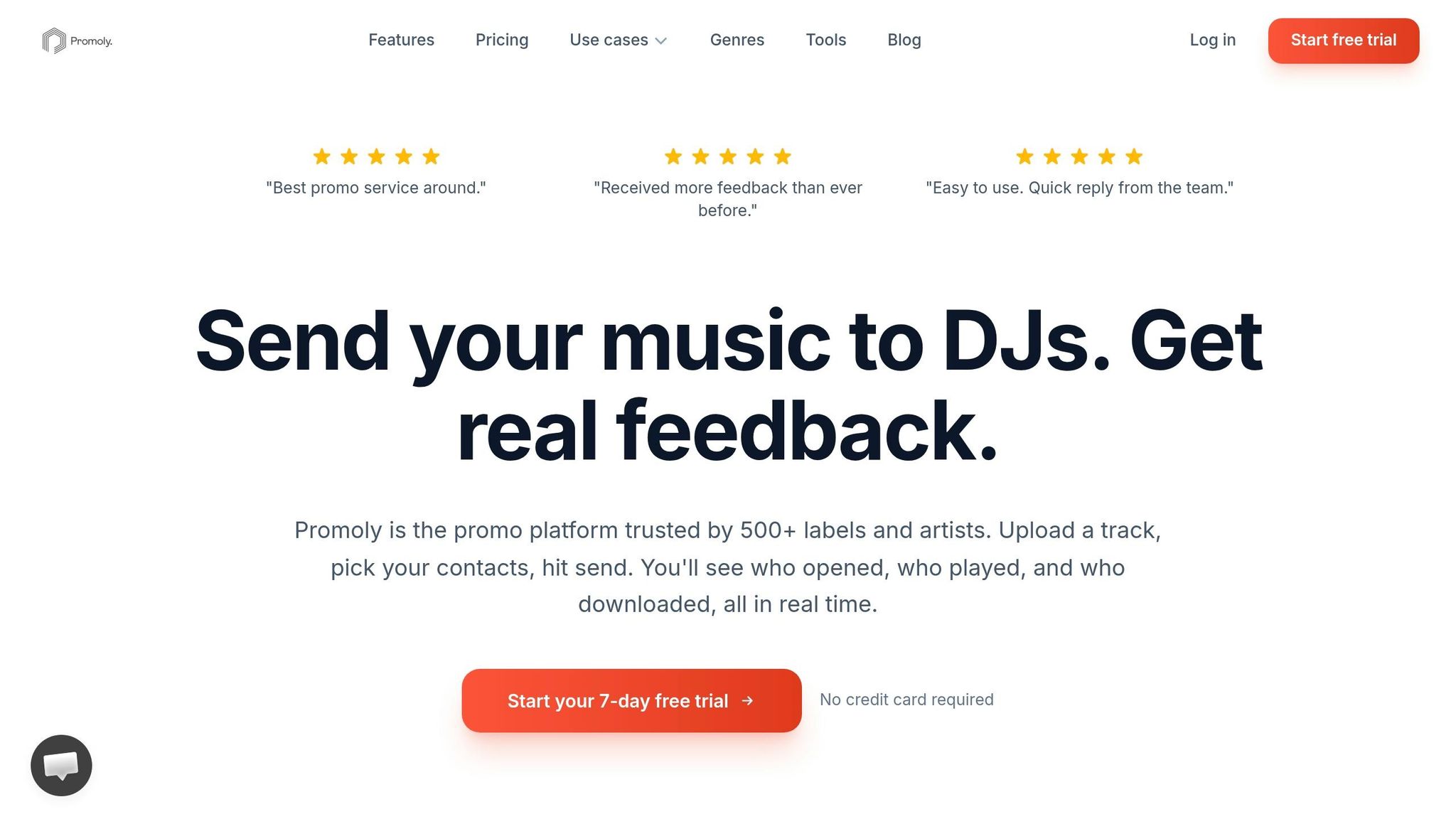
Email remains one of the most effective tools for music promotion, but making the most of it requires the right platform. That’s where Promoly comes in. Designed specifically for labels and artists, Promoly helps you send professional promo emails, gather valuable feedback, and track performance – all from one easy-to-use dashboard. Here’s how its features can elevate your campaigns.
Promoly leverages email’s impressive ROI and high open rates by offering granular tracking. This feature gives you real-time insights into who opened your email, played your track, or downloaded your audio. These detailed metrics let you identify your most engaged contacts and focus your follow-up efforts where they matter most. For instance, if a DJ listens to your track multiple times, it’s a clear sign of interest. With all data – such as opens, plays, downloads, and feedback – consolidated in one dashboard, you can quickly evaluate your campaign’s success.
A standout element of Promoly is its feedback collection feature. Before recipients can download a track, they’re required to rate and comment, ensuring you gather meaningful insights with every interaction. As TJ Flanders from Never Say Die Records explains:
It takes about one minute to start and send a campaign but still has everything you need.
Promoly’s effectiveness is further highlighted by its average open rate of 73%, which far surpasses the typical 20–30% average for standard email marketing campaigns.
The platform also includes automated reminders, which re-engage recipients who haven’t opened your promo yet, boosting overall engagement with minimal effort. On top of that, the Tastemaker Network connects you with over 1,300 DJs who are eager to discover new music, expanding your promotional reach beyond your current mailing list.
For even broader insights, Promoly’s smartlink feature tracks engagement across nine streaming platforms – including Spotify, Apple Music, and Beatport – using a single link. With a 4.5/5 rating on Capterra, Promoly simplifies the entire email campaign process while delivering the data you need to make informed decisions for your music promotion efforts.
Combining Email and Social Media for Better Results
Pairing email and social media can be a game-changer for music promotion. Think of social media as your discovery tool – the place where new listeners find you. Email, on the other hand, is your relationship builder – the tool that nurtures connections and drives sales. As digital strategist Garrett John Law explains, "Social media builds awareness. Email marketing drives revenue". This balance is key to crafting a winning promotional strategy.
When you combine social media’s ability to reach a broad audience with email’s knack for converting interest into action, you create a powerful funnel system. Social platforms help you grab attention, while email lets you connect on a more personal level. For instance, share engaging posts to attract listeners, and always include clear calls-to-action encouraging followers to sign up for exclusive perks – like unreleased tracks, early ticket access, or behind-the-scenes content. Even your link-in-bio should work for you, directing fans to an email signup page instead of just a streaming link.
Here’s the thing: email consistently delivers better ROI and engagement than social media. While social media provides quick exposure, it often falls short in driving conversions. That’s why an 80/20 hybrid approach works so well. Put 80% of your effort into high-impact channels like email and live shows, and 20% into social media to maintain visibility and credibility.
To make this hybrid strategy even smoother, consider using tools like Promoly to manage your email campaigns. Automate welcome sequences that trigger as soon as someone subscribes through your social channels, ensuring you capitalize on their initial interest. Promoly’s tracking features can also help you identify your most engaged subscribers, allowing you to tailor social media content specifically for them. The goal? Create a seamless system where email and social media work together, amplifying each other’s strengths.
Conclusion
Deciding between email and social media for music promotion isn’t about picking one over the other – it’s about using each channel’s strengths to meet your goals. Social media shines when it comes to discovery and creating buzz, making it perfect for attracting new listeners and generating viral moments. On the other hand, email marketing is the go-to for driving revenue and fostering deeper connections with your most dedicated fans.
As highlighted, email consistently delivers a stronger ROI compared to social media. However, the effectiveness of each channel depends on your audience. Younger listeners tend to gravitate toward social media, while older fans often prefer the directness of email.
The best strategy blends both platforms. Use social media to grab attention and grow your email list – offering perks like exclusive content can be a great incentive. Then, rely on email to turn subscribers into ticket buyers, merchandise customers, and loyal fans. This combination ensures both discovery and conversion work hand in hand.
Tools like Promoly make this process easier by automating email sequences, tracking results in real time, and gathering feedback. By aligning your approach with your audience’s preferences, you can let each platform do what it does best, creating a more effective and streamlined promotional strategy.
FAQs
How do I get more fans to join my email list?
To expand your email list, start by diving into audience research to figure out what truly drives your fans. What excites them? What do they value? Once you know, offer irresistible incentives – think exclusive content, early access to events, or special perks – to encourage them to join.
Make subscribing effortless. Add sign-up forms to your website and social media platforms, ensuring they’re easy to spot and quick to complete. Don’t stop there – consistently promote your list through posts, stories, and clear calls to action that grab attention.
Lastly, focus on building a sense of community. When fans feel connected and valued, they’re more likely to stay engaged and loyal to your updates.
What should I email fans (and how often)?
To keep your audience engaged, focus on delivering targeted, meaningful content that resonates with your fans. A good rule of thumb is to send 2–3 emails per week – this strikes a balance between staying on their radar and avoiding inbox fatigue.
For key moments like major events or releases, consider increasing your email frequency. This helps build anticipation and keeps your fans in the loop when it matters most.
Remember the 80/20 rule: a small portion of your audience – your most engaged fans – often drives the majority of your results. Prioritize this group by crafting personalized content that keeps them informed and feeling connected.
How do I track which promos actually lead to streams or sales?
To figure out which promotions are boosting streams or sales, leverage analytics tools and tracking methods like UTM parameters. These help you monitor traffic sources and conversions effectively. Pay close attention to engagement metrics such as click-through rates, open rates, and sales data. By analyzing these numbers, you can see what’s working and fine-tune your campaigns to achieve even better results.
Leave a Reply