Category: Uncategorized

  • Email vs Social Media: Best Channel for Music Promos

    Email vs Social Media: Best Channel for Music Promos

    When promoting music, should you prioritize email or social media? Here’s the short answer:

    • Email is best for driving revenue, with an average ROI of $36 per $1 spent and open rates of 20–30%. It’s a reliable way to connect directly with fans, free from social media algorithms.
    • Social media excels at discovery, reaching new audiences quickly. Platforms like TikTok can expose your music to thousands, but organic reach is limited to 5–10% of followers.

    Key takeaway: Use email to build lasting relationships and boost sales. Use social media to create buzz and attract new listeners. The smartest strategy combines both channels.

    Quick Comparison

    Metric Email Social Media
    ROI $36 per $1 spent $2.80 per $1 spent
    Reach/Open Rate 20–30% 5–10% organic reach
    Conversion Rate ~3.19% ~0.71%
    Audience Ownership You own it Platform-controlled
    Best For Sales, loyalty Discovery, awareness

    Want the best results? Use social media to grow your email list, then rely on email for personalized, high-impact campaigns.
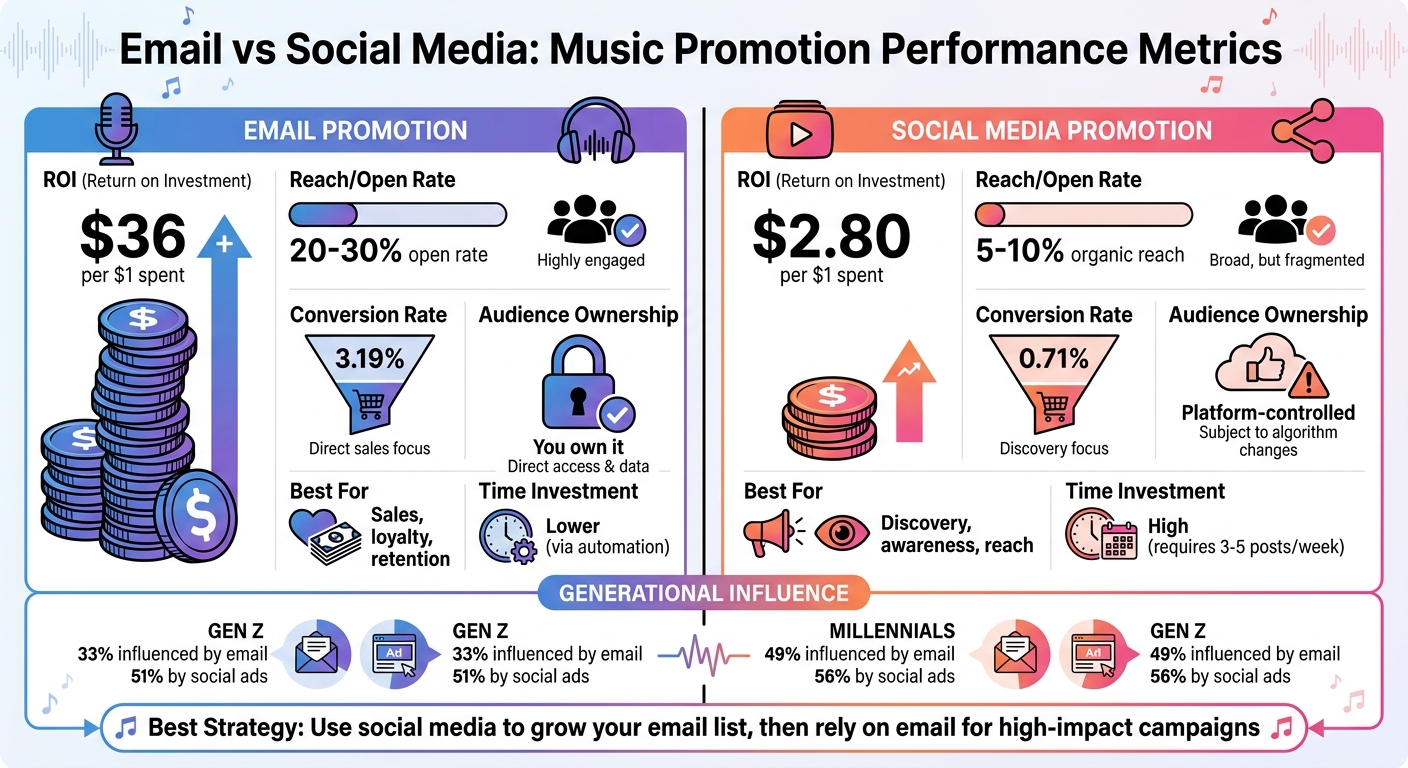
    Email vs Social Media Marketing for Musicians: ROI, Reach, and Conversion Comparison

    Email vs Social Media Marketing for Musicians: ROI, Reach, and Conversion Comparison

    Email for Music Promotion: Pros and Cons

    Benefits of Email for Music Promotion

    One of the standout advantages of email is that it gives you full control over your audience. Unlike social media platforms, where algorithms decide who sees your posts, email allows you to reach your fans directly, whenever you want. As the Musician Indie Coalition explains:

    Social media algorithms will always be out of your control, but your mailing list allows you to directly communicate with fans.

    The stats are compelling, too. Email open rates typically range between 20–30%, which is far higher than the 5–10% organic reach seen on social media. Even better, email offers an impressive return on investment – $36 for every $1 spent – compared to social media’s $2.80.

    Another big plus? Email lasts longer than social media trends. Fans might switch social platforms or lose interest in one app, but email addresses remain consistent over time. This makes email a reliable way to stay connected. It’s also a fantastic medium for delivering rich, exclusive content – think music videos, behind-the-scenes clips, or unreleased tracks – straight to your fans’ inboxes.

    Email also feels personal. It’s like having a 1-on-1 conversation with your fans, creating a deeper connection. This personal touch is great for turning casual listeners into loyal supporters who buy tickets, merch, and more. Plus, tools like Promoly can help you track engagement, showing who opened your emails, clicked on links, or downloaded your music.

    That said, email marketing isn’t without its hurdles.

    Drawbacks of Email for Music Promotion

    While email has plenty of advantages, it comes with some challenges. First, building an email list takes time – and you’ll need to use other channels to do it. Unlike social media, where a viral post can lead to instant exposure, email doesn’t help with discovery. You’ll need to rely on live shows, collaborations, or social media campaigns to drive people to sign up. This makes email most effective as part of a larger promotional strategy rather than a standalone tool.

    Another challenge is keeping your audience engaged. If your emails lack quality content or aren’t tailored to your fans’ interests, you could face high unsubscribe rates – sometimes as high as 60% per send. Segmentation is key here. If you’re not dividing your list by factors like location or engagement level, you risk alienating fans with irrelevant messages.

    Deliverability is another issue. Even the best-written emails won’t matter if they end up in spam folders. Maintaining a good sender reputation requires consistent, high-quality content. Additionally, there’s a generational divide to consider: while 51% of consumers from older generations are influenced by email, only 33% of Gen Z say the same. Younger audiences often respond better to social media ads.

    Finally, email marketing demands time and effort. From creating a content calendar to setting up automated sequences and running regular tests, there’s a lot to manage. For independent artists already balancing production, performances, and promotion, this workload can feel overwhelming.

    Social Media for Music Promotion: Pros and Cons

    Benefits of Social Media for Music Promotion

    One of social media’s greatest advantages is its ability to help new artists get discovered. Unlike email, which requires you to build an audience over time, platforms like TikTok can expose your music to thousands – sometimes millions – of people overnight. In fact, over 75% of TikTok users discover new artists or songs on the platform, and 63% hear songs there before streaming them elsewhere. That kind of reach is tough to replicate through traditional email campaigns.

    The results speak for themselves. Songs featured in over 100,000 TikTok videos often see a 250% jump in Spotify streams within just two weeks. This was the case for hits like FIFTY FIFTY’s "Cupid" and Doja Cat’s "Paint the Town Red", which climbed to the top of global charts.

    Each platform offers its own unique strengths. Chris Park, Digital Strategy Lead at PromoTrack, highlights this distinction:

    "TikTok is for discovery and viral potential; Instagram is for brand building and community."

    TikTok functions as a discovery engine, testing your content with small groups and amplifying it if it resonates quickly. Meanwhile, Instagram serves as a tool for nurturing relationships through DMs, Stories, and other features. YouTube adds another layer by offering monetization options like Content ID, additional visibility through Shorts, and long-term credibility with music videos.

    Social media also enables real-time fan interaction, something email can’t quite match. Features like live streams, comments, duets, and challenges allow fans to connect with your music instantly. This participatory culture is reflected in the fact that nearly 40% of all TikTok engagement revolves around music-related content. Plus, platforms now include "Add to music app" buttons, making it easier for fans to save songs directly to Spotify or Apple Music.

    The best part? You don’t need a huge marketing budget to get started. A simple TikTok account and a short video clip can potentially reach thousands, even if you’re starting from scratch. But while the exposure is massive, it comes with some trade-offs that can affect your long-term strategy.

    Drawbacks of Social Media for Music Promotion

    For all its benefits, social media has its downsides, especially when it comes to maintaining control over your audience and results. Unlike email lists, where you own the contact information, social platforms dictate how far your content can reach. Algorithms often limit organic visibility, meaning your posts might only be seen by a fraction of your followers. Compare this to email, which boasts open rates between 30% and 50% – a much more direct way of reaching fans.

    Another challenge is the ever-changing nature of algorithms. As Garrett John Law points out:

    "A viral post today doesn’t guarantee future success."

    Platforms like TikTok and Instagram constantly tweak their algorithms, so what works one week might fall flat the next. To stay visible, artists often need to post 3 to 5 times a week on TikTok, with similar demands on Instagram. For independent musicians already balancing production and performances, this can quickly lead to burnout. And even with high follower counts, social media doesn’t always convert well into ticket sales or music purchases compared to direct channels like email.

    Then there’s the question of return on investment (ROI). While social media ads are relatively affordable – TikTok’s CPM ranges from $2 to $6, and Instagram’s from $4 to $12 – the overall ROI is much lower than email marketing. For every $1 spent, email marketing typically generates $36, compared to just $2.80 from social media campaigns.

    Finally, the sheer volume of content on platforms like TikTok and Instagram makes it harder to stand out. As GPM Music Group notes:

    "Social media content on TikTok and Instagram Reels should now be aimed at nurturing your existing audience, as well as slowly and consistently finding new eyes."

    Gone are the days when overnight virality was common. With so much competition, breaking through now requires a well-thought-out, multi-channel strategy.

    Instagram, Spotify, ads, and email – the artist funnel
    Spotify

    Performance Metrics: Email vs Social Media

    When it comes to performance metrics, the differences between email and social media marketing are hard to ignore. Let’s start with ROI: email marketing delivers $36 for every $1 spent, while social media trails behind at just $2.80. That’s a massive gap, and it directly impacts your profitability.

    Now, think about visibility. Email campaigns boast open rates between 20% and 30%, whereas social media’s organic reach struggles at just 5% to 10%. This means your email content is far more likely to land in front of your audience compared to a social media post.

    And what about conversions? Email campaigns convert at around 3.19%, so if you have 1,000 subscribers, about 32 people will take action – whether it’s streaming a song, buying tickets, or purchasing merchandise. Social media, on the other hand, has a much lower conversion rate of 0.71%.

    Demographics also play a big role. Younger generations, like Gen Z and Millennials, are more influenced by social media ads. 56% of Millennials and 51% of Gen Z report making purchases based on social media ads. However, older generations, including Gen X and Boomers, tend to respond better to email promotions. For example, 49% of Millennials are influenced by email, compared to only 33% of Gen Z. This highlights the importance of knowing your audience and choosing the right channel based on their preferences and habits.

    Here’s a quick breakdown of these metrics for easy comparison:

    Comparison Table

    Metric Email Marketing Social Media Marketing
    Average ROI $36 per $1 spent $2.80 per $1 spent
    Open/Reach Rate 20–30% 5–10% organic reach
    Conversion Rate ~3.19% ~0.71%
    Audience Ownership High – you own your list Low – platform controlled
    Primary Strength Sales, retention, loyalty Discovery, awareness, reach
    Time Investment Lower (via automation) High (requires frequent posting)
    Purchase Influence (Gen Z) 33% 51% (ads) / 48% (posts)
    Purchase Influence (Millennials) 49% 56% (ads) / 53% (posts)
    Audience Growth Speed Slow (opt-in required) Fast (viral potential)

    This data makes it clear: while both channels have their strengths, email often delivers stronger results for retention and sales, while social media shines in discovery and awareness. The challenge lies in using each channel strategically to complement your overall marketing goals.

    Case Studies of Successful Campaigns

    Email Campaign Examples

    The Beaches showcased how a well-thought-out email strategy can transform fan engagement. Manager Laurie Lee expanded the band’s email list from 1,500 to 6,000 subscribers in just 30 days – a 300% jump – by gamifying Instagram story replies to encourage sign-ups. When they used this list to promote a new release, the results were staggering: streams doubled, and saves tripled compared to a previous EP that relied solely on Spotify playlisting. A merch drop email also saw a 195% click-through rate as superfans engaged multiple times.

    "The listeners might be lower, but the streams are double and the saves are triple." – Laurie Lee, Manager, The Beaches

    Other artists have also seen impressive results with personalized email campaigns. Corey Smith, for instance, partnered with Venture Music in August 2024 to launch "Special Reserve Small Batch Songs", an exclusive email series featuring unreleased tracks from his archives. This strategy was a game-changer: two emails drove 77% of vinyl sales for his Suburban Drawl release and boosted his Spotify monthly listeners by 119,000.

    Similarly, electronic music producer Flume used Campaign Monitor to promote his album Skin. His emails included a free track download and personalized touches, leading to a 50% click-through rate. The campaign also grew his subscriber base by a staggering 2,420%, and the album climbed to #8 on the Billboard 200.

    Social Media Campaign Examples

    While email campaigns build lasting connections, social media campaigns excel at creating buzz and driving immediate engagement.

    Cooper Alan demonstrated this with his Instagram DM automation strategy. By encouraging fans to comment "snippet" to receive exclusive song previews, he generated 40,000 presaves. This engagement helped his album debut at #1 on the Country iTunes Album Chart.

    Sabrina Carpenter took a creative approach to launch her single "Espresso" in April 2024. She invited fans to DM a brown heart emoji ("🤎") for a sneak peek, fueling massive anticipation. This strategy helped the song rack up over 2 billion streams in 2024. She later applied the same method for her tour, which sold out instantly and cut bot activity by 50% compared to traditional ticketing platforms.

    Corey Smith also tapped into social media’s potential. His TikTok and Facebook videos attracted millions of views and 742,600 TikTok likes, further boosting his Spotify monthly listeners by 119,000.

    How to Choose the Right Channel for Your Audience

    Picking the right channel starts with understanding your objective. Social media excels at creating buzz and sparking discovery, while email is your go-to for turning interest into revenue. With higher ROI and open rates than social media, email consistently proves to be the better option for driving conversions. These differences are key to tailoring your promotional strategy based on your audience’s habits.

    Age matters a lot. Only 33% of Gen Z consumers are influenced to buy through email, but 51% respond to social media ads. On the other hand, 49% of Millennials have made purchases through email campaigns, and the numbers climb even higher for Gen X and Boomers. If your audience leans younger, platforms like Instagram and TikTok are your best bet. For older listeners, focus on growing your email list.

    Your campaign’s goal is another major factor. If you’re launching a new single and need to generate buzz, social media’s real-time, shareable nature makes it the perfect choice. But when it comes to sales-driven campaigns, email consistently delivers better results in both reach and returns.

    The smartest approach is to use these channels together, not as competitors. Think of social media as your discovery tool – post engaging content, run ads, and grow your following. Then, use that momentum to build your email list by offering perks like early access to tickets or unreleased tracks. Here’s a telling stat: an email sent to 500 engaged subscribers can drive more release-day streams than a social media post seen by 5,000 followers.

    One of email marketing’s biggest strengths is ownership. Unlike social media, where algorithms control your reach and accounts can be suspended or lose relevance, your email list is entirely yours. As the Musician Indie Coalition explains:

    Fans tend to change social media accounts and shift preferences across platforms much more frequently than abandoning established email accounts.

    Email gives you a direct, dependable way to communicate with your audience, free from the unpredictability of social media platforms. By aligning your strategy with your audience’s preferences, you can ensure your promotional efforts hit the right notes.

    Next, we’ll dive into how blending these channels can take your music promotion to the next level.

    Using Promoly to Improve Email Campaigns
    Promoly

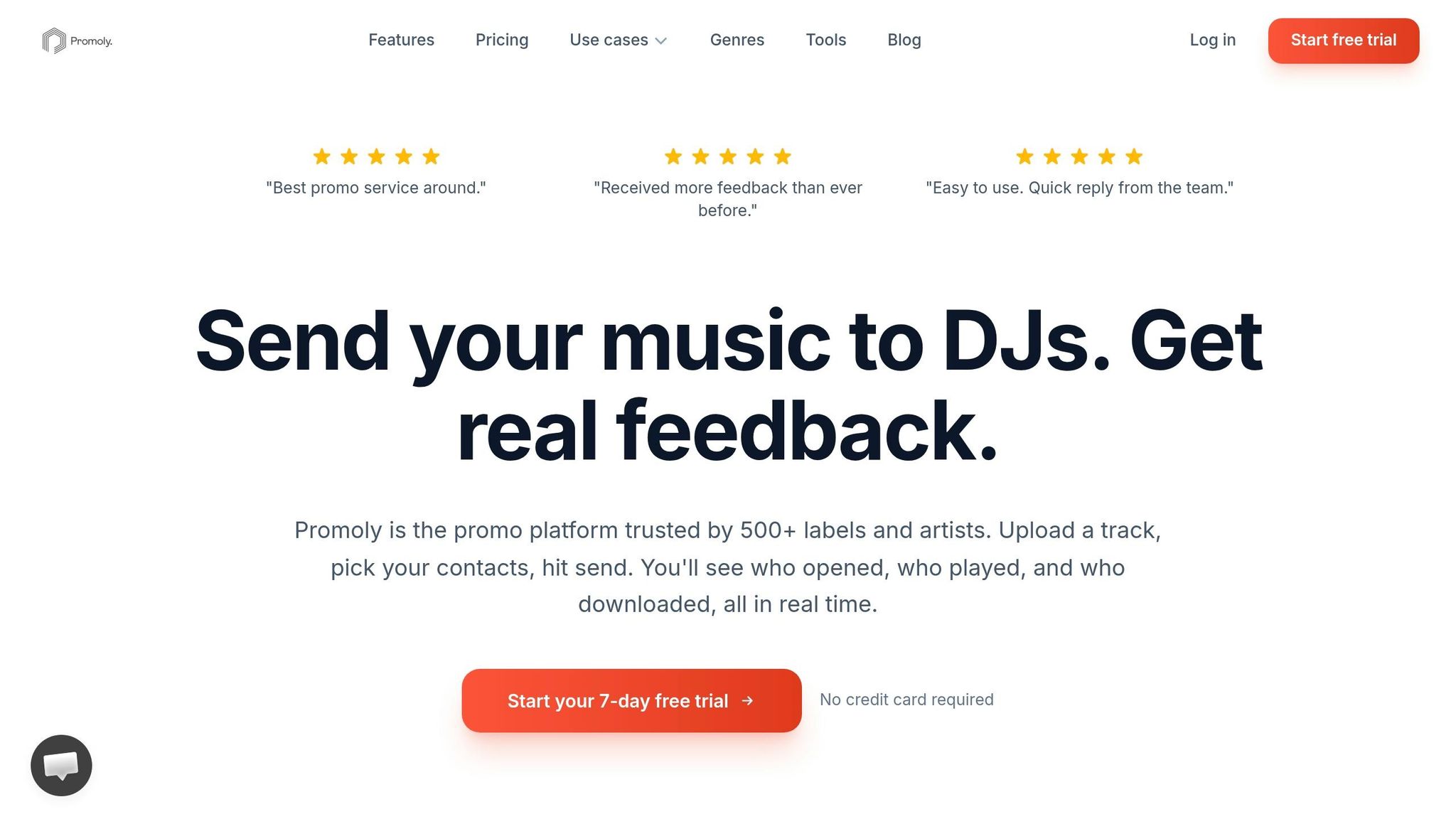
    Email remains one of the most effective tools for music promotion, but making the most of it requires the right platform. That’s where Promoly comes in. Designed specifically for labels and artists, Promoly helps you send professional promo emails, gather valuable feedback, and track performance – all from one easy-to-use dashboard. Here’s how its features can elevate your campaigns.

    Promoly leverages email’s impressive ROI and high open rates by offering granular tracking. This feature gives you real-time insights into who opened your email, played your track, or downloaded your audio. These detailed metrics let you identify your most engaged contacts and focus your follow-up efforts where they matter most. For instance, if a DJ listens to your track multiple times, it’s a clear sign of interest. With all data – such as opens, plays, downloads, and feedback – consolidated in one dashboard, you can quickly evaluate your campaign’s success.

    A standout element of Promoly is its feedback collection feature. Before recipients can download a track, they’re required to rate and comment, ensuring you gather meaningful insights with every interaction. As TJ Flanders from Never Say Die Records explains:

    It takes about one minute to start and send a campaign but still has everything you need.

    Promoly’s effectiveness is further highlighted by its average open rate of 73%, which far surpasses the typical 20–30% average for standard email marketing campaigns.

    The platform also includes automated reminders, which re-engage recipients who haven’t opened your promo yet, boosting overall engagement with minimal effort. On top of that, the Tastemaker Network connects you with over 1,300 DJs who are eager to discover new music, expanding your promotional reach beyond your current mailing list.

    For even broader insights, Promoly’s smartlink feature tracks engagement across nine streaming platforms – including Spotify, Apple Music, and Beatport – using a single link. With a 4.5/5 rating on Capterra, Promoly simplifies the entire email campaign process while delivering the data you need to make informed decisions for your music promotion efforts.

    Combining Email and Social Media for Better Results

    Pairing email and social media can be a game-changer for music promotion. Think of social media as your discovery tool – the place where new listeners find you. Email, on the other hand, is your relationship builder – the tool that nurtures connections and drives sales. As digital strategist Garrett John Law explains, "Social media builds awareness. Email marketing drives revenue". This balance is key to crafting a winning promotional strategy.

    When you combine social media’s ability to reach a broad audience with email’s knack for converting interest into action, you create a powerful funnel system. Social platforms help you grab attention, while email lets you connect on a more personal level. For instance, share engaging posts to attract listeners, and always include clear calls-to-action encouraging followers to sign up for exclusive perks – like unreleased tracks, early ticket access, or behind-the-scenes content. Even your link-in-bio should work for you, directing fans to an email signup page instead of just a streaming link.

    Here’s the thing: email consistently delivers better ROI and engagement than social media. While social media provides quick exposure, it often falls short in driving conversions. That’s why an 80/20 hybrid approach works so well. Put 80% of your effort into high-impact channels like email and live shows, and 20% into social media to maintain visibility and credibility.

    To make this hybrid strategy even smoother, consider using tools like Promoly to manage your email campaigns. Automate welcome sequences that trigger as soon as someone subscribes through your social channels, ensuring you capitalize on their initial interest. Promoly’s tracking features can also help you identify your most engaged subscribers, allowing you to tailor social media content specifically for them. The goal? Create a seamless system where email and social media work together, amplifying each other’s strengths.

    Conclusion

    Deciding between email and social media for music promotion isn’t about picking one over the other – it’s about using each channel’s strengths to meet your goals. Social media shines when it comes to discovery and creating buzz, making it perfect for attracting new listeners and generating viral moments. On the other hand, email marketing is the go-to for driving revenue and fostering deeper connections with your most dedicated fans.

    As highlighted, email consistently delivers a stronger ROI compared to social media. However, the effectiveness of each channel depends on your audience. Younger listeners tend to gravitate toward social media, while older fans often prefer the directness of email.

    The best strategy blends both platforms. Use social media to grab attention and grow your email list – offering perks like exclusive content can be a great incentive. Then, rely on email to turn subscribers into ticket buyers, merchandise customers, and loyal fans. This combination ensures both discovery and conversion work hand in hand.

    Tools like Promoly make this process easier by automating email sequences, tracking results in real time, and gathering feedback. By aligning your approach with your audience’s preferences, you can let each platform do what it does best, creating a more effective and streamlined promotional strategy.

    FAQs

    How do I get more fans to join my email list?

    To expand your email list, start by diving into audience research to figure out what truly drives your fans. What excites them? What do they value? Once you know, offer irresistible incentives – think exclusive content, early access to events, or special perks – to encourage them to join.

    Make subscribing effortless. Add sign-up forms to your website and social media platforms, ensuring they’re easy to spot and quick to complete. Don’t stop there – consistently promote your list through posts, stories, and clear calls to action that grab attention.

    Lastly, focus on building a sense of community. When fans feel connected and valued, they’re more likely to stay engaged and loyal to your updates.

    What should I email fans (and how often)?

    To keep your audience engaged, focus on delivering targeted, meaningful content that resonates with your fans. A good rule of thumb is to send 2–3 emails per week – this strikes a balance between staying on their radar and avoiding inbox fatigue.

    For key moments like major events or releases, consider increasing your email frequency. This helps build anticipation and keeps your fans in the loop when it matters most.

    Remember the 80/20 rule: a small portion of your audience – your most engaged fans – often drives the majority of your results. Prioritize this group by crafting personalized content that keeps them informed and feeling connected.

    How do I track which promos actually lead to streams or sales?

    To figure out which promotions are boosting streams or sales, leverage analytics tools and tracking methods like UTM parameters. These help you monitor traffic sources and conversions effectively. Pay close attention to engagement metrics such as click-through rates, open rates, and sales data. By analyzing these numbers, you can see what’s working and fine-tune your campaigns to achieve even better results.

    Related Blog Posts

  • Music Promotion Checklist: 15 Tasks Before Launch Day

    Music Promotion Checklist: 15 Tasks Before Launch Day

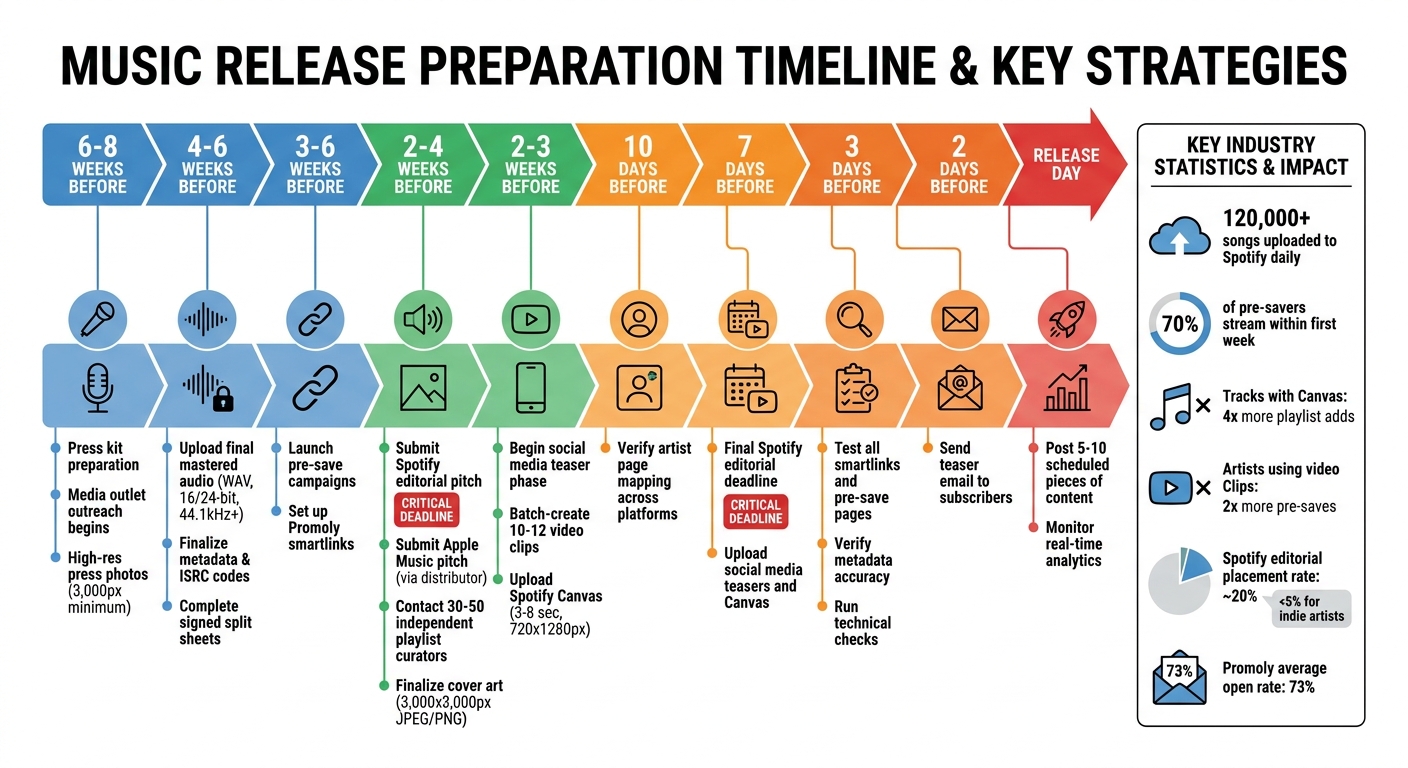
    Releasing music without a plan is a common mistake that can hinder success. To make your launch impactful, preparation is key. This checklist covers everything you need to do 6–8 weeks before release day to ensure your music gets the attention it deserves.

    Key Takeaways:

    • Mastered Audio: Upload uncompressed WAV files (16-bit/24-bit, 44.1kHz+) and finalize metadata like ISRC codes and ownership splits.
    • Cover Art & Visuals: Ensure artwork is 3,000×3,000 pixels in JPEG/PNG format. Add press photos, Spotify Canvas (3–8 sec videos), and teaser clips.
    • Pre-Save Campaigns: Launch 3–6 weeks ahead using platforms like Promoly to boost early streams and algorithmic placement.
    • Playlist Outreach: Submit pitches to Spotify and Apple Music 2–4 weeks in advance. Contact independent curators for wider exposure.
    • Press & Profiles: Update artist profiles, write a press kit, and reach out to media outlets 6–8 weeks before release.

    Quick Tips:

    1. Submit to Spotify editorial playlists at least 7 days before release.
    2. Use Promoly smartlinks for pre-save and streaming platforms.
    3. Test all links, metadata, and visuals 3 days before launch.

    With 120,000 songs uploaded daily to Spotify, standing out requires a well-organized campaign. This checklist ensures nothing critical is missed, setting your release up for success.

    Music Release Timeline: 6-8 Week Pre-Launch Checklist

    Music Release Timeline: 6-8 Week Pre-Launch Checklist

    The Ultimate Step-by-Step Guide to Promoting Your Music Release | Music Biz 101

    Section 1: Core Promotional Materials

    Your audio files, visuals, and teaser content are the backbone of your promotional efforts. Without these ready to go early on, you’ll hit roadblocks in distribution, pitching, and social media campaigns.

    Complete Final Mastered Audio Files

    Start by uploading your finalized, uncompressed WAV files (16-bit or 24-bit, 44.1kHz or higher). This ensures you avoid quality loss when platforms compress your audio. Submit these files 4–6 weeks before release to allow platforms enough time for processing and editorial pitching. Additionally, prepare instrumental, clean (radio edit), and stem versions. These open up opportunities for sync licensing and remixes. Don’t forget to label tracks as "explicit" if they contain profanity – this helps avoid playlist removal or age restrictions.

    Metadata is just as critical as the audio itself. Apple Music for Artists emphasizes that accurate metadata is "essential to building and growing an audience", and errors can disrupt your release schedule or promotional efforts. Assign each track an ISRC code to track streams and royalties. If you’re switching distributors for a re-release, keep the same ISRC to avoid splitting your streaming data. Also, finalize a signed split sheet before uploading to confirm ownership percentages and prevent future royalty disputes.

    Once your audio and metadata are in order, it’s time to focus on creating compelling visuals.

    Finalize Cover Art and Photos

    With your audio ready, turn your attention to visuals that will make your release stand out. Your cover art should meet industry guidelines: a minimum resolution of 3,000 x 3,000 pixels, saved as a JPEG or PNG in RGB color mode. Avoid including URLs, social media handles, pricing, or misleading text. Test the design at thumbnail size to ensure any text remains readable.

    "Poor artwork signals amateur status to playlist editors, press, and listeners." – Orphiq

    In addition to your cover art, prepare 2–3 high-resolution press photos. These should be in portrait, landscape, and close-up formats with at least 3,000 pixels on the longest edge. Adapt these images for various platforms: square crops for Spotify, vertical formats for Instagram Stories and TikTok, and landscape versions for YouTube or Twitter headers. If you’re releasing singles ahead of a larger project, ensure each piece of artwork ties into the overall design theme.

    Another visual tool to consider is a Spotify Canvas – a short 3–8 second looping vertical video (720 x 1280 pixels, 9:16 ratio). Tracks with a Canvas are saved or added to playlists over 4x more often than those without one. Plus, when listeners share tracks with a Canvas to Instagram or Facebook Stories, the visual is included in the post, boosting exposure.

    Once your visuals are polished, move on to creating teaser videos to build anticipation.

    Create Short Teaser Videos

    Pair your finalized audio and visuals with short, engaging video teasers to drive social media buzz and pre-saves. Create 3–5 vertical teaser clips (10–30 seconds each) designed for TikTok, Instagram Reels, and YouTube Shorts. Artists who use video Clips on their Spotify Countdown Pages report an average of 2x more pre-saves compared to those who don’t. To save time, batch-produce 10–12 clips in one session, using different outfits and backgrounds to keep your content fresh.

    Experiment with a mix of performance footage, lip-syncs in interesting locations (outdoor settings often perform better), lyric previews, and behind-the-scenes moments. Start each teaser with an attention-grabbing hook, like: "Ever written a song at 2 a.m. that just hits differently?" This helps stop the scroll and draw people in. Use your original audio in these clips so fans can repurpose the sound in their own content, allowing your song to spread organically.

    Plan your rollout in phases. Start teasing 2–3 weeks before release with cryptic hints or studio shots. Then, as the release date gets closer, focus on the main hook and include clear calls to action for pre-saves. If it’s a collaboration, take advantage of social media’s "Collab" post features to tap into both artists’ audiences and maximize engagement.

    Section 2: Digital Campaign Setup

    With your promotional materials ready to go, now’s the time to set up the digital framework that will drive excitement and engagement before your release. These campaigns transform casual listeners into loyal fans eager to support your launch.

    Build Pre-Save Campaigns with Promoly

    Promoly

    Pre-save campaigns are a great way to ensure your music reaches fans on platforms like Spotify, Apple Music, and Deezer the moment it drops. These campaigns let fans add your upcoming release to their libraries ahead of time, so they’re ready to stream on day one. To make the most of this, launch your pre-save campaign 3–6 weeks before your release date. This timing helps you take advantage of platform algorithms during the crucial first 72 hours after launch.

    Promoly makes setting up pre-save campaigns simple. Just paste your track’s URI during setup, and the platform automates the process. You can customize your landing page with your cover art, a countdown timer, and an audio preview to give fans a sneak peek of your music. Want to track visitor behavior? Integrate a Facebook Pixel to build remarketing audiences. Then, share your pre-save link everywhere – your Instagram bio, TikTok profile, email signature, and social posts – to maximize engagement. Don’t forget to consolidate all your links to make them easy to access.

    Once your pre-save campaign is running, take it a step further with smartlinks. These links gather all your streaming platforms into one easy-to-navigate page, making it simple for fans to choose their preferred service. Instead of manually searching for links for platforms like Spotify, Apple Music, or Beatport, just enter your UPC into Promoly. It automatically pulls metadata and links from nine streaming services.

    As Promoly puts it:

    "Paste a UPC and Promoly finds your release on Spotify, Apple Music, Beatport, and more. Turn any link into a pre-save page for upcoming releases."

    Your smartlink page can do more than just host streaming links. Add audio files, video links, press releases, and track descriptions to create a comprehensive hub for your release. You can even convert it into a pre-save page for future campaigns. Before sharing, test the link on both mobile and desktop to ensure it works flawlessly. Use this as your go-to "Link in Bio" for platforms like Instagram and TikTok. With Promoly’s real-time dashboard, you can track opens, plays, and downloads to see which platforms your audience prefers, allowing you to adjust your marketing efforts accordingly.

    Prepare Short-Form Video Content

    With your pre-save campaigns and smartlinks in place, focus on creating engaging short-form video content to keep the momentum going. Plan to batch-produce 6–10 videos, each lasting 15–30 seconds, to cover your release week and beyond. Organize your content into distinct phases: Tease (3 weeks before), Hype (2 weeks before), Launch (release week), and Sustain (weeks 2–4 after release).

    Use your track as the background sound in TikTok videos to directly connect views to your music. Start each video with a strong hook to grab attention immediately. If you’re collaborating with another artist, take advantage of Instagram’s collaborative post feature to reach both audiences at once. To maintain a consistent presence during your launch, schedule your content in advance using tools like Hootsuite or Metricool. Keep in mind that algorithms favor consistent engagement, so posting once in the morning and then going silent could mean missing out on key opportunities.

    Section 3: Playlist and Press Outreach

    Once your digital campaigns are live, the next step is getting your music in front of playlist curators and media contacts. These individuals act as gatekeepers who can introduce your work to entirely new audiences. To succeed, you’ll need to approach them with thoughtful, personalized pitches and a well-planned timeline.

    Write Playlist Pitches for Spotify and Apple Music

    Spotify

    Start by submitting concise, targeted pitches well before your release date. For Spotify, use the Spotify for Artists platform and submit your pitch at least 2–4 weeks ahead of time. Apple Music requires 3–4 weeks’ notice, as pitches must go through your distributor. While Spotify reports that roughly 20% of pitched tracks land on playlists, independent artists often see placement rates below 5%.

    When crafting your pitch, focus on what makes your song stand out – its mood, tempo, and instrumentation. Avoid diving into how the song was made. Use relatable comparisons, like referencing artists or styles (e.g., "similar to early Bon Iver"), to help curators quickly understand your sound. Remember, Spotify limits pitches to 500 characters, while Amazon Music allows up to 1,000. Start strong, as curators often only listen to the first 30 seconds.

    Venture Music emphasizes:

    "The first sentence of your pitch should focus on your song’s mood, moments, and emotions, not its process or topic."

    Include specific marketing plans, such as ad campaigns, upcoming tour dates, or viral TikTok trends connected to your song. Suggest playlists or scenarios where your track fits – for instance, "late-night driving" or "Sunday morning moods." Be precise when tagging your genre (e.g., "Dream Pop" rather than just "Pop") to ensure your pitch reaches the right editorial team. Avoid vague claims like "this song is a hit" and use descriptive, objective language instead, such as "high-energy, electric summer anthem."

    While waiting for responses from platform editors, start reaching out to independent curators to maximize your playlist exposure.

    Contact Independent Playlist Curators

    Independent playlist curators can be a valuable resource, especially those managing playlists with 500 to 50,000 followers. Aim to contact 30–50 curators for each release.

    To find curators, look for user-created playlists on Spotify (not editorial ones) that have been updated within the past six months and align with your genre. Around 40% of curators include contact details in their playlist descriptions. If not, check their Instagram or X (Twitter) profiles for submission links. You can also explore Discord servers, Facebook groups, or subreddits like r/SpotifyPlaylists to locate active curators.

    Personalize every pitch. Mention a specific song already on their playlist and explain how your track fits, such as "between Artist A and Artist B". Keep email pitches between 100–150 words and Instagram DMs between 50–75 words. Always include a direct Spotify link instead of attaching MP3 files, which could trigger spam filters. Follow up once, about 7–10 days after your initial message.

    As Orphiq advises:

    "The artists who build lasting curator relationships are the ones who treat curators as collaborators, not gatekeepers."

    Steer clear of curators offering "guaranteed placement" for a fee or charging per 1,000 streams. These services are often bot-driven scams that could get your music removed from platforms.

    Prepare Press Kit and Media Contact List

    Once your playlist outreach is underway, shift your attention to media contacts to strengthen your credibility. A well-crafted press kit is essential for this step. It should include:

    • A professional artist bio that tells your story in a concise, engaging way.
    • 2–3 high-resolution photos (minimum 3,000 pixels on the longest side) in different compositions.
    • Private streaming links via platforms like SoundCloud or Dropbox for unreleased music.
    • A one-paragraph release description that highlights the "hook" of your project – whether it’s a notable collaboration, an interesting concept, or a compelling narrative.

    Next, build a media contact list of 30–50 outlets that align with your genre. Use a spreadsheet to track essential details like outlet name, contact person, email, pitch date, follow-up date, and results. You can find contacts through blog bylines, masthead pages, or the social media profiles of music writers. Keep in mind that most blogs and online magazines need 6–8 weeks of lead time for coverage, while print publications may require 8–12 weeks.

    When writing pitch emails, keep them under 200 words. Lead with the hook, rather than a lengthy backstory. If you don’t hear back, follow up once, 5–7 days later. If there’s still no response, move on to avoid being flagged as spam by editors. For a DIY campaign targeting 30–50 outlets, landing 3–5 placements is considered a solid outcome.

    As JC Sanchez, Founder & CEO of Orphiq, explains:

    "The real value of PR is not the individual placement. It is the credibility layer. When a potential fan, booking agent, or label A&R searches your name and finds multiple press mentions, you look like an artist with momentum."

    Section 4: Platform Profile Updates

    Once your playlist and press outreach plans are in motion, it’s time to focus on the platforms where listeners will discover and stream your music. Your artist profiles are often the first impression for potential fans, so they need to be polished and aligned with your brand. Updating visuals, bios, and key details ensures your profiles reflect your latest release.

    Update Spotify for Artists Profile

    Spotify for Artists

    Start by giving your profile a fresh look. Update your profile picture (minimum 750 x 750 px) and header image (minimum 2660 x 1140 px) to match the branding of your new release. Don’t forget to rewrite your bio (up to 1,500 characters) to highlight the project, your genre, and recent milestones. Pay attention to how the header image crops on both mobile and desktop views to keep the focal point intact.

    Take advantage of the Artist Pick feature to pin your new release, a playlist, or a Countdown Page to the top of your profile. Add a short caption (100 characters max) to make it stand out. Statistics show that nearly 70% of users who pre-save an album on Spotify stream it within its first week. To boost pre-saves, upload short vertical videos (under 30 seconds) as Clips to your Countdown Page – artists who use Clips typically see double the pre-saves compared to those who don’t.

    If you haven’t already, enable Canvas on your tracks. Songs with Canvas see a 145% increase in social shares and 20% more playlist adds. Also, double-check that your social media links (Instagram, X, Facebook) and website URL are accurate and functional. If you’re selling merch or planning a tour, sync your Shopify store and ensure ticketing partners like Ticketmaster or AXS are correctly displaying your upcoming dates. Over half of all merch clicks on Spotify happen within the first 24 days of a release.

    Don’t stop with Spotify – update your Apple Music and YouTube profiles too. Ensure your artist name, featured artists, and track titles match across platforms to avoid duplicate pages or mapping errors. Upload your music to distributors 4–6 weeks ahead of release to allow time for metadata corrections. Apple Music specifically advises mapping music to the correct artist page at least 10 days before release to ensure "New Release Insights" are ready on launch day.

    With your profiles in top shape, you’re ready to focus on connecting with tastemakers for additional exposure.

    Send Promoly Promo Mailouts to Tastemakers

    Promoly is a great tool for sending promo mailouts to DJs and tastemakers, boasting an average open rate of 73%. You can either upload your own contact lists or tap into the Tastemaker Network, which includes over 1,300 DJs sorted by genre, region, or prior engagement.

    To encourage meaningful feedback, require recipients to rate and comment on tracks before downloading them. This feedback can be invaluable when pitching to Spotify or Apple Music editorial playlists. Promoly’s dashboard provides real-time tracking of opens, plays, and downloads, making it easy to monitor your campaign’s performance. Automated reminders can also reach tastemakers who haven’t opened the promo yet, boosting overall engagement without extra manual work.

    Jorge Brea, CEO of Symphonic Distribution, emphasizes the platform’s impact:

    "We feel much happier knowing that our client base has a strong piece of software to help manage their music promotion business."

    Creating and sending a campaign on Promoly takes just 60 seconds, and the platform is trusted by over 500 labels worldwide, including Never Say Die Records and Symphonic Distribution.

    Launch Promoly Event Campaigns

    Event campaigns on Promoly are another excellent way to build excitement before your release. These campaigns allow you to set up automated reminders, keeping your release at the forefront of your audience’s mind. The platform’s AI tools can help you craft promotional copy and identify the most relevant contacts for your release.

    Event campaigns work hand-in-hand with pre-save and smartlink campaigns, creating multiple opportunities to engage your audience. Use the real-time data to identify tastemakers who are interacting with your content and prioritize personal follow-ups with those who show strong interest. By launch day, this multi-layered approach ensures you’ve already built momentum with key figures who can help amplify your music.

    Section 5: Pre-Launch Final Checks

    You’ve built your campaign, updated your profiles, and reached out to tastemakers. Now, it’s time to tie everything together. The final days before launch are all about double-checking, not creating. These steps ensure that everything you’ve worked on leads to a smooth and impactful launch day.

    Send Teaser Emails to Subscribers

    Your email list is a goldmine – these are people already invested in your music. A few days before your release, send a teaser email to re-engage subscribers and build anticipation. Keep it short and engaging, with a clear call-to-action directing them to your pre-save page or smartlink.

    Before sending, test the email on mobile devices and confirm that all links and images display correctly across different email platforms. A glitchy email can break the momentum, so this step is crucial.

    Build and Test Content Calendar

    With your assets ready, it’s time to ensure everything is set for launch-day execution. A well-structured content calendar keeps you on track and eliminates last-minute scrambling. Divide your calendar into four key phases:

    • Tease (4–2 weeks before): Create curiosity and build awareness.
    • Hype (2–1 weeks before): Intensify excitement and engagement.
    • Launch (release week): Focus on high-frequency posting to drive streams.
    • Sustain (1–4 weeks after): Keep the momentum going with follow-ups and fresh content.

    Dedicate a few hours to batch-create your content. This includes filming 10+ vertical video clips, designing static graphics, and preparing lyric snippets. Schedule 5–10 posts for release day, spaced out to cover morning, midday, and evening. As JC Sanchez, Founder & CEO of Orphiq, advises:

    "One owner per task. Not ‘the team.’ Not ‘we.’ One name. If everyone owns it, no one owns it."

    Before locking in your calendar, double-check that your artist name is consistent across all platforms. NotNoise sums it up perfectly:

    "A release is not ready because the audio file exists. It is ready when every click has somewhere intelligent to go."

    Run Final Technical Tests

    The last 72 hours are all about testing and verifying. This is your chance to make sure everything is functioning as planned. Here’s what to focus on:

    • Ensure all audio files, cover art (minimum 3,000 x 3,000 pixels), and Spotify Canvas (9:16 vertical format) are correctly uploaded to your distributor.
    • Double-check metadata, including track titles, artist names, featured credits, and explicit content flags. These details are difficult to fix after the release goes live.
    • Test all smartlinks and pre-save pages across platforms like Instagram, email signatures, and story stickers on both iOS and Android. Confirm that links transition smoothly from pre-save to live mode on launch day.

    Set up analytics tracking via Promoly to monitor engagement in real time. This allows you to identify tastemakers who are actively supporting your promo and follow up personally. Additionally, confirm that your Spotify editorial pitch was submitted at least 7 days before the release date to improve your chances of appearing on Release Radar playlists.

    Task Category Item to Double-Check Deadline
    Technical Smartlink/pre-save functionality 3 days before
    Technical Artist page mapping (Spotify/Apple Music) 10 days before
    Assets Spotify Canvas & Social Media Teasers 7 days before
    Metadata Songwriter credits and ISRC codes 28 days before
    Promotion Email announcement draft and test send 2 days before

    Keep in mind that streaming platforms heavily weigh early performance for algorithmic placement. Any technical hiccup in the first 48 hours can hinder your song’s trajectory. By handling these final checks, you’re setting yourself up to make the most of your launch window.

    Conclusion

    This checklist lays the groundwork for your release strategy, ensuring every detail is accounted for to set your launch up for success. Skipping this preparation is like trying to build a house without a solid base. With 120,000 new songs uploaded to Spotify daily, the difference between a standout campaign and one that falls flat often comes down to readiness – not just the quality of your music.

    As Orphiq puts it:

    "Most releases do not fail because the song is bad. They fail because something was late, missing, or formatted wrong."

    The pressure is high. Missing critical pre-launch tasks – like editorial pitches, metadata accuracy, or pre-save campaigns – can severely impact your release’s performance, especially during those crucial first 24 hours when streaming platforms weigh algorithmic placement the most. These steps aren’t just minor details – they’re the backbone of a campaign that can either gain traction or fade away. Every item on the checklist contributes to the overall success of your release.

    Promoly takes your digital campaign a step further by turning scattered social media buzz into measurable outcomes. Instead of relying on vague impressions, Promoly provides real-time insights into who’s engaging, which regions are responding, and where your momentum is building. Its smartlinks seamlessly switch from pre-save mode to streaming mode on launch day, ensuring every click translates into streams. Additionally, Promoly’s promo mailouts and event campaigns let you track tastemaker engagement, making it easier to follow up with precision.

    FAQs

    What should I do if my ISRC or credits are wrong after release?

    If your ISRC or credits are incorrect after your release, reach out to your distributor or the digital platform right away to update the metadata. Timely corrections are essential to ensure accurate reporting and proper royalty collection.

    How do I choose which independent playlists to pitch first?

    To get started, look for playlists that match your genre, style, and target audience. Pay attention to ones with active curators, engaged followers, and a track record of featuring artists like you. Focus on playlists that accept submissions and are known for supporting up-and-coming acts – these can be a great way to gain early momentum. By prioritizing playlists that are a good fit and have an engaged audience, you’ll boost your chances of success before moving on to bigger, more competitive options.

    What should I track in the first 72 hours to boost algorithmic reach?

    To maximize your content’s reach in the critical first 72 hours, focus on tracking key engagement metrics. Look at social media interactions, playlist adds, and media coverage. Monitor how fans are engaging with your posts, the number of playlists featuring your content, and any mentions in blogs or media outlets. This data offers valuable insights into your initial momentum and helps you fine-tune your promotion strategy for better results.

    Related Blog Posts

  • How to Promote Your Music Release in 2026: 12 Proven Steps

    How to Promote Your Music Release in 2026: 12 Proven Steps

    In 2026, releasing music is easy, but getting it heard is the real challenge. With 1.8 million tracks uploaded weekly, standing out requires more than talent – it demands strategy. Here’s what works:

    • Start Early: Begin promotion 6–8 weeks before release day.
    • Leverage Short-Form Platforms: 67% of Gen Z discovers music on TikTok and Instagram Reels.
    • Focus on Algorithms: Save rates, playlist adds, and video completions drive visibility.
    • Use Pre-Save Campaigns: Boost engagement before release to signal streaming platforms.
    • Submit to Playlists: Pitch unreleased tracks to Spotify editors at least 4 weeks in advance.
    • Build Social Media Presence: Post consistently, use trends, and engage directly with fans.

    Success comes from combining tools like playlist placements, social media, and live events with a data-driven approach. Treat promotion as half the job, and you’ll rise above the noise.


    For a quick breakdown, the article details 12 steps, from uploading music to organizing events, each designed to maximize reach and engagement. Dive into the full guide for actionable tips on how to connect with listeners and grow your audience.

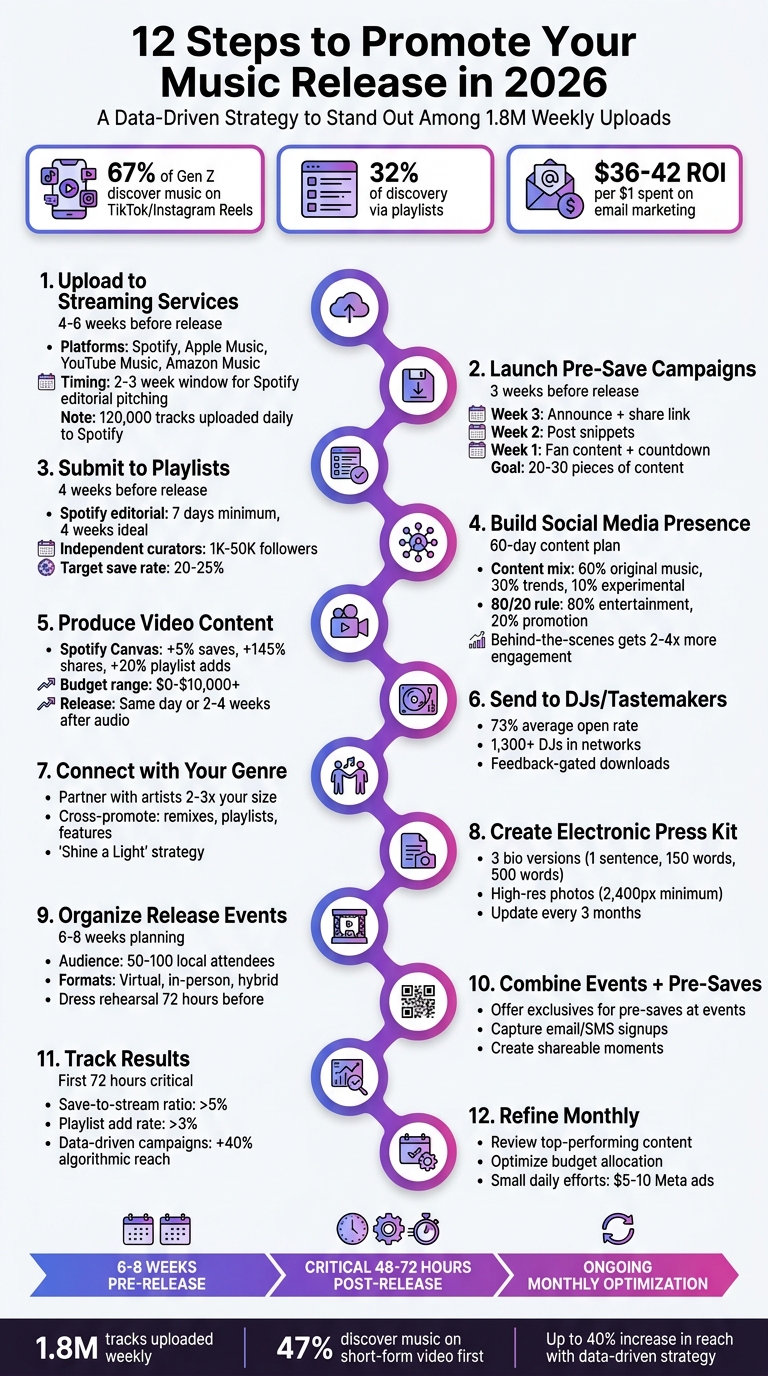
    12 Steps to Promote Your Music Release in 2026

    12 Steps to Promote Your Music Release in 2026

    How To Promote A Single In 2026 (THE 60-DAY PLAN) MAJOR UPDATE!

    Step 1: Upload Your Music to All Major Streaming Services

    To get your music out into the world, start by uploading it to all the major streaming platforms – Spotify, Apple Music, YouTube Music, Amazon Music, and other digital service providers. A digital distributor like DistroKid, TuneCore, Amuse, or CD Baby can handle this for you, ensuring your music reaches every platform.

    Timing is everything. Upload your master at least 4–6 weeks before release. This gives enough time for processing and leaves a 2–3 week window for pitching your track to Spotify’s editorial team. With over 120,000 tracks uploaded to Spotify daily, delays can cost you valuable opportunities. This step lays the groundwork for the promotional strategies you’ll use later.

    Get Your Metadata Right

    Metadata might not sound exciting, but it’s critical. Mistakes like incorrect genre tags, missing mood descriptors, or inconsistent artist name spellings can limit your reach. As Florencia Flores from NotNoise explains:

    "Wrong genre tags mean Spotify serves your music to the wrong audience, killing your algorithmic performance."

    Be meticulous – double-check every field, from genre and mood to instrumentation and similar artists. And always use the exact same artist name across platforms to avoid creating duplicate profiles.

    Prepare Visual Assets

    Strong visuals can make a big difference. Design 3,000×3,000-pixel cover art that grabs attention and consider creating a Spotify Canvas – a 3 to 8 second looping video that plays during your track on mobile devices. Tracks with Canvas often see better engagement.

    Once your release is live, claim your artist profiles on Spotify and Apple Music. This allows you to update your bio, upload photos, track analytics, and secure verification.

    Don’t Forget Royalties

    To make sure you get paid for your work, register your music with a Performance Rights Organization like ASCAP or BMI, and with SoundExchange. While distribution puts your music in stores, registration ensures you collect royalties every time your track is played.

    Step 2: Launch Pre-Save Campaigns Before Release Day

    A pre-save campaign is a powerful way to build anticipation and ensure your track gains traction the moment it’s released. By allowing platforms to automatically add your song to listeners’ libraries upon release, pre-saves create an instant engagement boost right when algorithms are paying the closest attention.

    "Pre-saves compress listener action into the exact moment algorithms are measuring engagement most closely." – Sonikit Blog

    Timing matters because streaming platforms focus heavily on save rates – the percentage of listeners who save your track to their libraries. A surge in pre-saves can help your song land on Release Radar and personalized discovery feeds, giving it a strong start.

    Smartlinks simplify this process by providing a single link that directs users to their preferred streaming service, whether it’s Spotify, Apple Music, or YouTube. This eliminates the hassle of managing multiple URLs and helps track which traffic sources are driving the most conversions. Tools like Promoly make it easy to set up smartlinks and monitor performance.

    To make the most of your pre-save campaign, plan it over three weeks:

    • Week Three: Announce your release with behind-the-scenes content and share your pre-save link.
    • Week Two: Post song snippets and insights into the production process.
    • Week One: Ramp up excitement with fan-generated content and a final countdown.

    Aim to create 20–30 pieces of short-form content during this time to keep your pre-save link visible across all audience segments. Sweeten the deal by offering exclusives, like early access to the track, lyric sheets, or bonus footage, to encourage more pre-saves.

    Once your pre-save campaign sets the stage with a strong first-day signal, you’ll be ready to take the next step: connecting with playlists and music curators to expand your reach.

    Step 3: Submit Your Music to Playlists and Curators

    Getting your music featured on the right playlists can dramatically expand your audience. Spotify editorial playlists are the ultimate goal – they’re curated by Spotify’s in-house team and can introduce your tracks to millions of listeners. To get considered, you’ll need to submit through the Spotify for Artists portal, and here’s the catch: you can only pitch unreleased tracks. Why? Editors prefer to build buzz from the very beginning [24,25].

    Timing matters. Submit your track at least 7 days before your release date, though aiming for 4 weeks in advance gives you the best chance of being reviewed by Spotify editors [4,25]. Your pitch is limited to 500 characters, so make it count. Skip the clichés like “genre-defying” and focus on specifics. Share the story behind the song – mention your inspiration, any sync deals, upcoming tours, or even early audience feedback [24,25].

    Before you hit submit, double-check your metadata. Accurate details help both algorithms and human curators understand your music better.

    Reaching Out to Independent Curators

    Independent curators – those managing playlists with 1,000 to 50,000 followers – are another great avenue to promote your music. When reaching out, personalization is key. Mention the playlist by name and explain briefly why your track fits their style. Keep your message under 150 words and include a direct Spotify link to your song. If you don’t hear back, it’s okay to follow up once after a week.

    Avoid Paid Placement Services

    Be cautious of services that promise playlist placements for a fee. These often rely on bots, which can lead to your track being removed – or worse, your account being suspended [4,25]. Instead, focus on building genuine connections with curators who genuinely align with your music.

    Keep an eye on your save rate – a strong rate of 20% to 25% indicates that listeners are connecting with your music. This can also help trigger Spotify’s algorithmic playlists, like Discover Weekly and Release Radar.

    Once your playlist strategy is in motion, shift your focus to growing your social media presence to keep the momentum going throughout your release cycle.

    Step 4: Build Your Social Media Presence

    Social media has become a driving force for music discovery. By 2026, nearly half (47%) of listeners discover new songs on platforms like TikTok and Instagram Reels before they even reach streaming services. Even more striking, 75% of TikTok users eventually listen to those songs on streaming platforms. This makes having a consistent presence on social media essential – it’s what powers your streaming numbers.

    To stay visible, stick to a 60-day content plan across TikTok, Instagram, and YouTube. Start teasing your release four weeks in advance, launch a pre-save campaign two weeks before, and ramp up your content efforts on release day and beyond. For example, you could post lyric videos by day 15, drop the official music video by day 29, and create an "Open Verse Challenge" by day 36.

    On TikTok, focus on creating 60–90 second "Anchor" videos that dive into the story behind your song. These longer clips set the stage for impactful 15-second snippets. On Instagram, aim for a mix of 7–15 second Reels, behind-the-scenes Stories, and exclusive content through Broadcast Channels. Broadcast Channels are particularly useful because they deliver directly to 100% of subscribers, bypassing the usual algorithm.

    TikTok

    Jumping on trends is one of the quickest ways to grow your audience. Artists who align with TikTok trends experience an 11% week-over-week boost in streaming, compared to just 3% for those who don’t. In fact, 84% of songs that made it onto the Billboard Global 200 in 2024 went viral on TikTok first.

    Use tools like the TikTok Creative Center to stay on top of trending hashtags, songs, and formats. Spend a few minutes each day scrolling your "For You" page to spot what’s gaining traction. When you find a trend that resonates with your style, adapt it to make it your own. In 2026, the focus is less about copying trends and more about tailoring them to reflect your genre, emotions, and personality. Also, make sure your song’s hook lands within the first 1–3 seconds of your video to grab attention right away.

    On Instagram, the algorithm now prioritizes personalized topic selection for Reels. Creators who align their content with these topics see a reach increase of 40–50%. A good content strategy here might include 60% original music, 30% trending sounds, and 10% experimental or conversational posts. Don’t forget to use features like Duets and Stitches to interact with fans and boost engagement.

    Mix Different Content Types

    Keeping your audience engaged requires variety. A good rule of thumb is the 80/20 rule: dedicate 80% of your content to entertainment or value – like storytelling, behind-the-scenes clips, or day-in-the-life videos – and only 20% to direct promotion. Interestingly, behind-the-scenes studio content often generates 2 to 4 times more engagement than polished promotional posts.

    Maximize your reach by repurposing one 60-second "Anchor" video into 5–10 shorter clips for platforms like TikTok, Instagram Reels, and YouTube Shorts. Use Instagram Stories daily for quick updates, countdowns, and fan interactions. And keep in mind that over 80% of Instagram Reels with sound enabled are watched by users, with an average engagement rate of 2.46%.

    Lastly, take the time to respond to DMs and comments whenever possible. These personal interactions can transform casual listeners into loyal fans. In a world saturated with AI-generated content, raw and genuine moments often outperform highly polished promotional clips. Let your personality shine through.

    Once your social media presence is buzzing, you’ll be ready to focus on creating standout video content in the next step.

    Step 5: Produce Video Content for Your Release

    By 2026, video has become a cornerstone of music discovery. Platforms like YouTube, the second-largest search engine globally, make video an essential tool for connecting with listeners. In fact, 47% of listeners now discover new music on short-form platforms like TikTok and Instagram Reels before it even reaches streaming services. These platforms have essentially taken over the role radio once played in introducing audiences to fresh tracks. On top of that, video content can boost your track’s performance on streaming platforms. For instance, Spotify Canvas increases track saves by 5%, shares by 145%, and playlist adds by 20%.

    "A music video is a separate asset with its own lifecycle, algorithms, and audience." – Orphiq

    A single video shoot can go a long way. It can yield a full-length music video, short-form clips for social media, behind-the-scenes footage, Spotify Canvas loops, and even press images. This approach ensures you get the most out of your investment. Here’s a quick breakdown of what different types of video projects might cost:

    • Lyric videos/visualizers: $0–$500
    • Performance videos: $500–$2,000
    • Multi-location shoots: $2,000–$10,000
    • Full productions with VFX: $10,000+

    Timing matters. To maximize impact, consider releasing your video on the same day as your audio. Alternatively, delay the video release by 2–4 weeks to create a second promotional wave. A popular strategy among artists is to drop the audio on a Friday and follow up with the music video on Tuesday or Wednesday, creating two distinct moments to capture attention. After the main video launch, maintain momentum by rolling out additional content like lyric videos, acoustic versions, or behind-the-scenes footage 2–4 weeks later.

    "A music video without a promotion strategy is like a billboard in the desert." – Florencia Flores, NotNoise

    Incorporating video into your release plan not only strengthens your social media presence but also enhances engagement on streaming platforms. These assets will also play a key role in your next step: reaching out to DJs, tastemakers, and curators.

    Step 6: Send Your Music to DJs and Tastemakers

    Once you’ve nailed your streaming and social strategies, it’s time to connect with key industry players. Sharing your music with DJs and tastemakers can amplify your release, exposing your tracks to thousands of listeners through live sets, radio shows, and social media. The tricky part? Reaching them efficiently while keeping tabs on their responses.

    Promoly makes this process quick and seamless. You can upload your tracks, include artwork, and send out promos in under a minute. Its UPC auto-fill feature pulls metadata directly from streaming platforms, saving you time and effort. Once your promo is live, you can track opens, plays, and downloads through an intuitive dashboard.

    "It takes about one minute to start and send a campaign but still has everything you need." – TJ Flanders, Never Say Die Records

    Promoly also offers access to its Tastemaker Network, which includes over 1,300 DJs who have opted in to receive new music. You can refine your recipient list by genre, region, or past engagement. On average, Promoly’s promo mailouts achieve an impressive 73% open rate.

    A standout feature is the feedback gate, which requires DJs to rate and comment on your track before they can download it. This ensures you receive meaningful feedback rather than being left in the dark. Plus, automated follow-ups handle unopened promos, sparing you the hassle of manual reminders. Promoly even offers a 7-day free trial, allowing 150 sends without needing a credit card.

    With DJs and tastemakers on board, you’re ready to take the next step: connecting directly with others in your genre in Step 7.

    Step 7: Connect with Others in Your Genre

    Building relationships with artists, bloggers, and influencers can create opportunities for long-term collaboration. The secret? Start by supporting others instead of diving straight into a pitch. Engage with the content of artists you admire – share their posts, leave thoughtful comments, and create playlists that mix their music with your own.

    When reaching out to journalists or bloggers, make it personal. Reference specific articles they’ve written that resonated with you, and build these connections well before your release. The same goes for fellow musicians: interact genuinely with their work before proposing a collaboration. When you do suggest working together, be specific – like saying, "I have a track that would pair perfectly with your vocal style."

    For cross-promotion, partner with artists whose audience size is within 2–3 times your own. Ideas include trading featured verses, doing remix swaps, or curating playlists together. A great example of this strategy in action is Sony Music’s 2025 campaign for The Script. They filmed content at the original location of their hit song, “The Man Who Can’t Be Moved,” with frontman Danny O’Donoghue sharing creative insights. This nostalgia-driven approach earned over 4 million TikTok views and boosted the band’s Spotify monthly listeners by 50%.

    Another effective approach is the "Shine a Light" strategy: publicly acknowledge your producers, mixers, and co-writers. This not only fosters goodwill but often leads to mutual support. You can also propose value-first exchanges, such as offering backstage access, meet-and-greets, or merchandise swaps, instead of simply asking for playlist placements.

    To organize your outreach, think in three tiers:

    • Tier 1: Major outlets like Pitchfork or Rolling Stone (usually best tackled with professional PR).
    • Tier 2: Genre-specific blogs and influencers, where personalized emails referencing their past work can make a big impact.
    • Tier 3: Local media and niche forums, where direct community engagement is essential.

    Keep in mind that 32% of music discovery happens through editorial and algorithmic playlists. With 1.8 million new tracks uploaded weekly, a strong network can set you apart.

    Once you’ve built these connections, you’ll be ready to focus on creating and sharing your electronic press kit in the next step.

    Step 8: Create and Share Your Electronic Press Kit

    Your electronic press kit (EPK) serves as your digital resume for industry professionals. In 2026, the standard format is a web-based EPK – PDF attachments are outdated. Industry pros typically spend just 30 to 60 seconds scanning an EPK, so it’s crucial to make it easy for them to access streaming music and videos without needing to download files. A well-crafted EPK not only reinforces the digital presence you’ve built but also adds credibility to your outreach efforts.

    Start by writing three versions of your artist bio, all in the third person so that journalists can easily copy and paste them into articles. These should include:

    • A one-sentence elevator pitch.
    • A 150-word short bio.
    • A 500-word full bio.

    Next, include high-resolution press photos (minimum 2,400px) in various formats: landscape, portrait, and live performance shots.

    Embed two to three of your best tracks using Spotify or SoundCloud players, and include at least one high-quality live performance video. For festival organizers, raw live footage often carries more weight than a polished music video.

    "Most EPKs fail because they include everything the artist wants to say rather than everything the recipient needs to know." – Orphiq

    Your EPK should also feature specific social proof and streaming stats. Instead of vague claims like "growing fanbase", highlight concrete achievements such as "150,000 organic streams in the first month." Include notable press quotes, key performances, and other milestones. Additionally, add technical assets like a professional stage plot and technical rider to show you’re ready for large-scale events. Make all assets downloadable via a cloud storage link (e.g., Google Drive or Dropbox) so press and radio professionals can easily access high-resolution photos and broadcast-quality WAV files.

    When it’s time to share your EPK, adjust your approach based on your audience. For example:

    • Music blogs: Send your EPK 4–6 weeks before a release, along with a brief, personalized pitch.
    • College radio: Provide direct download links for broadcast-quality WAV files (16-bit, 44.1 kHz).
    • Festival organizers: Submit your EPK 6–9 months in advance, focusing on your audience draw and market data.

    Lastly, keep your EPK current. Update it every three months to remove old tour dates, refresh your stats, and ensure all links are active.

    With a polished and targeted EPK, you’ll be ready to make a strong impression and expand your promotional reach.

    Step 9: Organize Release Events and Performances

    Adding release events to your promotional efforts can transform your music launch into something truly memorable. These events take your music from a solo listening experience to a shared moment, creating buzz and excitement around your work. Plus, live performances remain a top income source for most musicians in 2026, offering not just financial opportunities but also a way to build deeper connections with your audience.

    "Releasing a record, EP, or single is no longer enough to cut through the noise. Live events create urgency, communal excitement, and direct paths for monetization." – Alex Mercer, Senior Editor & Live Events Strategist, Playful

    To make your event successful, start planning 6–8 weeks in advance. This timeline allows you to lock in ticket sales, garner press attention, and attract sponsorships. Begin by focusing on a local audience of 50–100 attendees before expanding to a regional scale. The format of your event should align with your goals. For example:

    • Virtual livestreams are great for global reach with minimal costs.
    • In-person listening parties create a closer, more intimate experience for superfans and press.
    • Hybrid events combine both, offering extras like backstage streams or virtual VIP rooms for remote participants while keeping the in-person energy alive.

    To make the most of your audience, divide them into three key groups – core superfans, casual listeners, and industry professionals – and tailor the experience to each.

    • Core superfans love exclusivity, so offer perks like early access or limited-edition merchandise.
    • Casual listeners are drawn to shareable moments, such as photo opportunities, surprise guests, or interactive activities they can post on social media.
    • Industry professionals need a polished presentation and a clear story about your music and brand.

    For virtual events, keep things engaging with features like chat-triggered visuals, audience polls, or unlocking new tracks when certain goals are met. These strategies keep your audience involved and excited throughout the event.

    Don’t skip the logistics! Run a full dress rehearsal 72 hours before the event to test all your equipment and ensure everything runs smoothly. For virtual and hybrid events, a high-speed wired internet connection is a must. After the event, act quickly – release a highlights reel and offer limited-time merchandise bundles within 24–72 hours to keep the momentum going.

    Timing is everything. Spotify pays close attention to activity on your tracks in the first 48 hours after release, so plan your event to boost saves and shares during this critical period.

    Step 10: Combine Event Campaigns with Pre-Save Strategies

    Pairing your release event with a pre-save campaign is a smart way to turn live energy into measurable fan engagement. While events create buzz and shareable moments, pre-saves translate that excitement into actions that platforms like Spotify can track, potentially boosting your visibility through algorithms.

    When done together, these strategies amplify both short-term excitement and long-term listener data. Think of it as a cycle: your event sparks emotional connection and social media buzz, while your pre-save campaign captures that momentum and channels it into actionable data. For instance, Warner Music Central Europe took this approach with Ed Sheeran’s album promotion. Surprise pub shows and pop-up performances in Germany, including a piano pop-up in Stuttgart, led to 156 million views from fan-shared content online. Imagine pairing such moments with pre-save calls-to-action – it’s a powerful way to engage fans when they’re most excited.

    Take advantage of your event to incentivize pre-saves. At in-person gatherings, you can offer perks like early access to unreleased tracks, exclusive lyric sheets, or behind-the-scenes footage in exchange for email or SMS signups. A great example of this is The Cure’s Songs of a Lost World campaign in September 2024. They used creative tactics like cryptic posters, UV-light-readable postcards, and password-protected 3D album art to build intrigue. This approach drove over 55,000 WhatsApp group signups.

    Platforms like Promoly make it easier to merge event campaigns with pre-save pages. They help you capture fan data, track which actions lead to pre-saves, and grow your own audience database. With around 120,000 tracks uploaded to Spotify daily in 2026, having a data-driven strategy is crucial to stand out.

    "Pre-saves don’t build relationships – Spotify owns that data, not you. If you’re going to ask fans for something, make it count: join your email list or text list." – Ariel Hyatt, Founder, Cyber PR

    Step 11: Track Results and Improve Your Approach

    Once your release is out, tracking its performance is what transforms random guesses into actionable insights. With your multi-channel strategy in place, real-time tracking allows you to tweak and refine your promotional efforts. The first 72 hours after release are especially important – this is when metrics like stream velocity, save rates, and playlist additions can determine whether platforms like Spotify’s Release Radar will spotlight your track.

    Tools like Promoly’s Campaign Dashboard and Snapshot Stats offer detailed, instant insights into how your audience is engaging with your music. You can monitor click-through rates, track how many casual listeners convert into fans, and even see whether your traffic is organic or paid. This granular data helps you spot potential red flags – like bot activity that could harm your algorithmic reach – and focus on strategies that foster genuine engagement.

    "Real-time data isn’t just a report card; it’s a compass. Monitoring campaign performance as it happens allows you to steer your strategy toward what’s actually working." – Artist.Tools

    Take time to review your results monthly. Look for trends in your top-performing content, platforms, and budget allocations. Metrics like a save-to-stream ratio above 5% and playlist add rates over 3% signal to algorithms that your music has traction. When you see these numbers, consider increasing your ad spend to amplify the momentum. If a specific TikTok sound or playlist is driving most of your traffic, shift your focus to creating more content around that success.

    Another key metric to track is your Audience Acquisition Cost (AAC). Divide your campaign spend by the number of new followers gained to see if you’re getting a good return on investment. Even small tweaks – like optimizing your Spotify bio with 3–5 relevant keywords – can boost search-driven traffic by up to 70%. Data-driven campaigns can also improve your algorithmic reach by as much as 40% in the first week, turning your release into a well-planned launch instead of a gamble. Use these insights to keep your strategy sharp and your promotional approach adaptive.

    Conclusion

    Promoting your music in 2026 means weaving together digital tools, creative content, and data analysis into one cohesive strategy. The 12 steps outlined here act as a "promotion stack", with each element boosting the others. Social media sparks discovery, smart links gather listener insights, playlists drive streams, and email marketing builds momentum for release day. When combined thoughtfully, this approach turns a music release into a calculated launch rather than a gamble.

    The stats back this up. 67% of Gen Z discover music through short-form videos on platforms like TikTok and Instagram Reels, while 32% of all music discovery comes from editorial and algorithmic playlists. Meanwhile, email marketing generates an impressive $36 to $42 for every $1 spent. With 1.8 million new tracks uploaded weekly in 2026, simply uploading your music and hoping for the best is no longer enough.

    Sustaining a music career requires more than just great songs – it’s about connecting with the right audience at the perfect time. Start planning 6–8 weeks before your release, focus heavily on the critical first 48 hours after launch, and use data insights to fine-tune your approach monthly. Key metrics like save rates, playlist adds, and engagement signals are vital for triggering algorithmic growth. Even small, consistent efforts – like posting behind-the-scenes content three times a week or running $5 to $10 daily Meta ads – can add up to big results over time.

    Treat each release as a strategic business investment. Use the strategies outlined here to build a multi-channel promotion plan, stay flexible as platforms evolve, and remember that coordinated, data-driven campaigns can increase your algorithmic reach by up to 40% in the first week. Focus on two or three channels, commit for six months, and let the data guide your next steps. The real difference between 100 streams and 10,000 streams often comes down to the strategy behind the music. By embracing a multi-channel, data-focused approach, you can turn every release into a calculated success.

    FAQs

    What should I do if my release gets delayed after I’ve started pitching and pre-saves?

    If your release gets delayed after you’ve already pitched it and set up pre-saves, it’s important to realign your promotional efforts with the new release date. Start by updating all pre-release tools, including pre-save links and any scheduled social media campaigns. Adjust your playlist pitches to reflect the new timeline.

    Make sure to communicate the delay clearly to your fans and professional contacts. Share updates about the new release date and provide revised links where necessary. It’s also a good idea to reschedule any press outreach to align with the updated launch.

    Keeping your audience engaged during this time is key. Regular communication and updates can help sustain excitement and ensure that interest in your release remains strong, even with the adjusted schedule.

    How can I tell if my streams and playlist adds are real or bot-driven?

    To figure out if your streams and playlist adds are legitimate, take a close look at engagement patterns and platform analytics. Keep an eye out for unusual spikes in streams or playlist additions that don’t align with social interactions like likes, shares, or comments. Metrics such as listener retention, engagement rate, and geographic distribution can provide valuable clues. For example, sudden jumps in numbers without any signs of organic growth often hint at bot activity. Make it a habit to review your analytics regularly to ensure everything checks out.

    What’s a realistic promo budget for an independent single in the U.S.?

    A typical promo budget for an independent single in the U.S. in 2026 usually falls between $200 and $3,000. The specific amount largely depends on the scale of your promotional efforts and the particular services you decide to invest in.

    Related Blog Posts